
AA Gallery Shop
La Tienda Online de Álvaro Alcázar Arte
ONLINE EXHIBITION | MATTHEW BENEDICT
Matthew Benedict x Patrick O’Brian: Aubrey-Maturin Series
The exhibition presents a selection of preparatory drawings created between 2019 and 2022 by New York-based artist Matthew Benedict for the new covers of the Aubrey–Maturin series by British writer Patrick O’Brian (1914–2000). Set during the Napoleonic Wars, the twenty novels published between 1969 and 1999 recount the adventures of Royal Navy Captain Jack Aubrey and his friend Stephen Maturin, a physician and naturalist, as they sail the world’s oceans. Translated into 24 languages and read by millions, the series became one of the defining works of modern maritime fiction. It was also adapted for the screen in Master and Commander: The Far Side of the World (2003). O’Brian left a twenty-first novel unfinished, which was subsequently published from his manuscript.
In 2019, American publisher W. W. Norton commissioned Benedict to create the images for a new edition of the series. The project comprised 42 works: 21 preparatory drawings and 21 finished paintings intended for the covers of the twenty volumes and the book based on the unfinished manuscript. Although Benedict did not usually work as an illustrator, the commission brought together several longstanding interests in his practice, including literature, historical maritime painting, and the relationship between image and fiction. The publisher also sought a fresh approach to the series’ cover art, which had until then been associated with British maritime painter Geoff Hunt. Benedict found a starting point in the American tradition of classic illustration, represented by artists such as N. C. Wyeth, Howard Pyle, J. C. Leyendecker, and Maxfield Parrish.
Over the course of three years, while reading the novels, Benedict researched the visual sources and maritime culture of the period with the assistance of Andrew J. Lyter, historian, writer, sailor, and Curator of Maritime History at Historic Lewes, Delaware. This research enabled him to explore the ships, ports, landscapes, and objects associated with O’Brian’s fictional world. Through atmosphere, framing, and carefully constructed situations, the artist develops his own visual interpretations, bringing historical accuracy into dialogue with the freedom of the imagination.
The exhibition focuses on the preparatory drawings, an essential part of the creative process that usually remains hidden behind the finished cover image. These works reveal the decisions that precede the final painting: the arrangement of the composition, the choice of viewpoint, the definition of ships and settings, and the search for a particular light or atmosphere. Drawing thus emerges not merely as a preliminary stage, but as a space for visual research and experimentation, where documentary references are gradually transformed into images.
Together, the works establish a dialogue between contemporary art, literature, and maritime history. By revealing how Benedict translates a fictional universe into a series of works on paper, the exhibition invites viewers to consider both the creative process and the resulting images: works that originate in Patrick O’Brian’s fiction yet develop a visual language of their own.
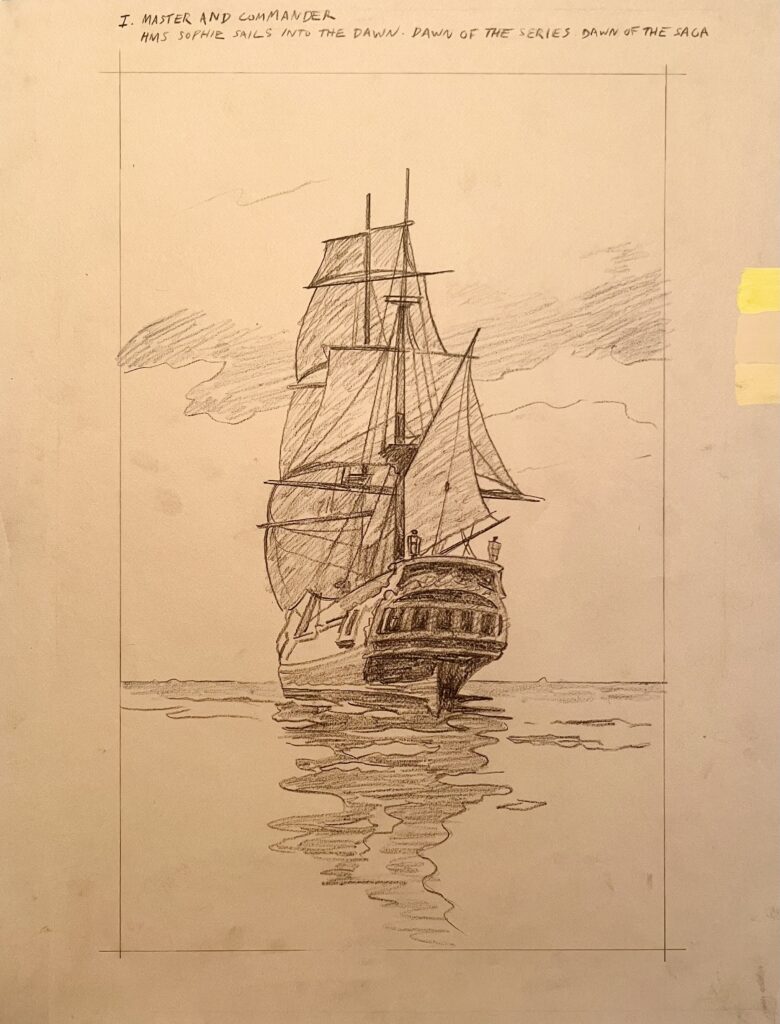
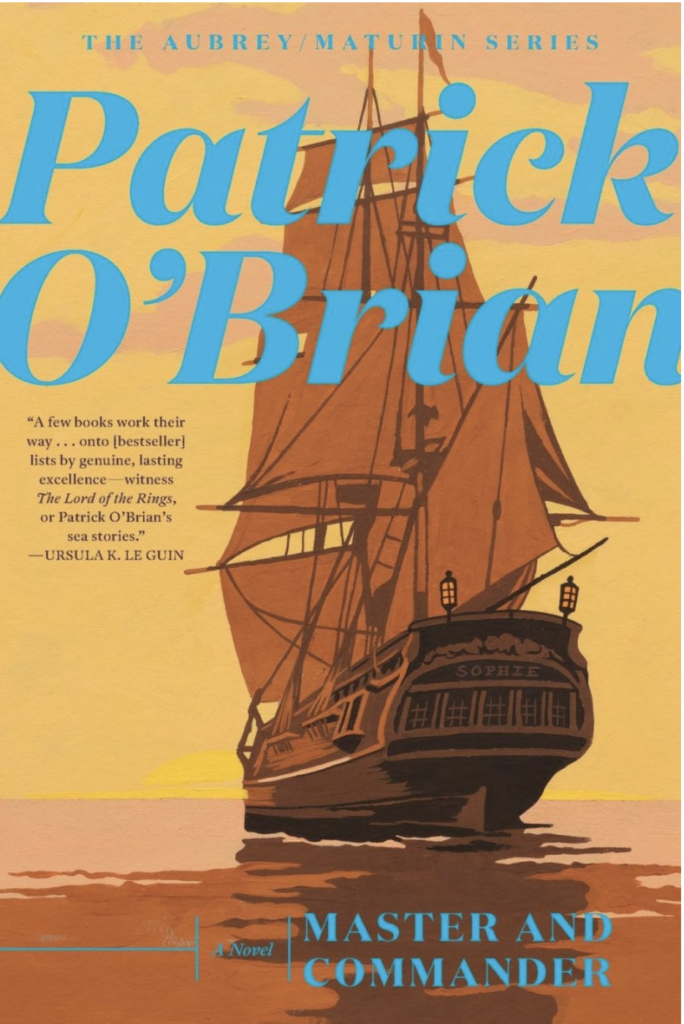
HMS Sophie sails into the down. The Dawn of the Saga (The Bounty)
MASTER AND COMMANDER (Book I)
Jack Aubrey’s first command, the fictional HMS Sophie, sails towards a golden dawn on the cover of Master and Commander, the first novel in Patrick O’Brian’s celebrated series. Although the Sophie never existed as such, O’Brian based the ship on real Royal Navy vessels from the early nineteenth century, particularly HMS Speedy.
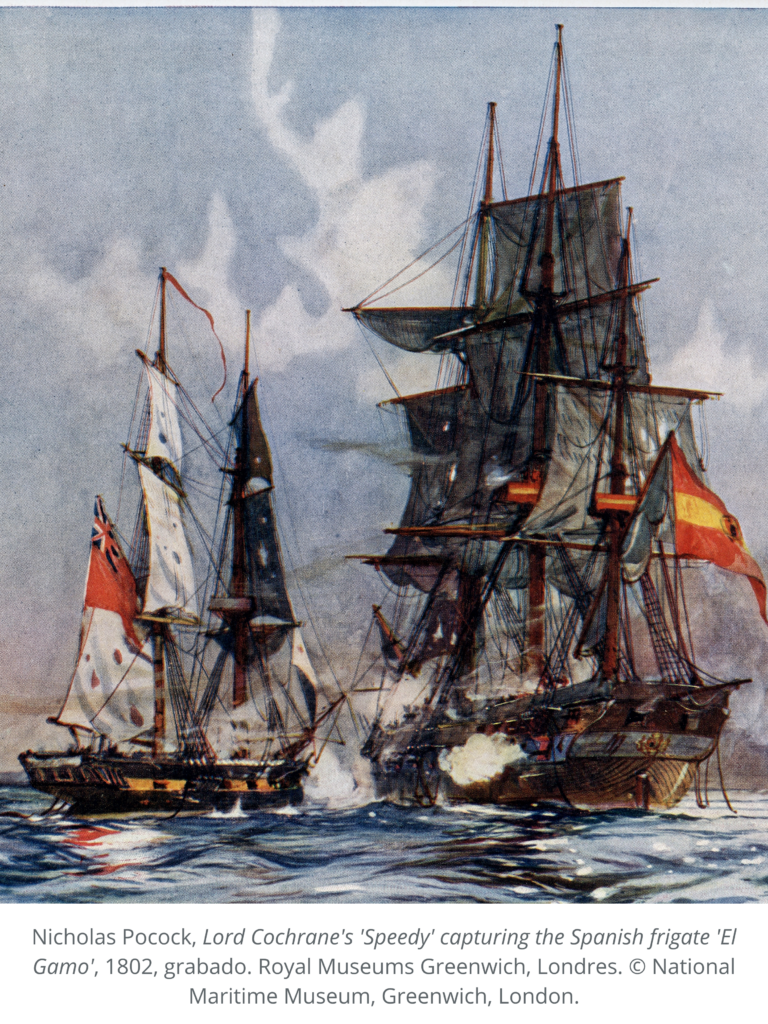
O’Brian’s inspiration extended beyond the ship’s design. He also incorporated real episodes from the career of Thomas Cochrane into Aubrey’s story. One of the most notable was the celebrated capture of the Spanish frigate El Gamo by the Speedy on 6 May 1801, off the coast of Barcelona. O’Brian transformed this historical encounter into the capture of the Cacafuego by the fictional Sophie.
On 6 May 1801, off the coast of Barcelona, the small British brig HMS Speedy, commanded by Thomas Cochrane, engaged the Spanish frigate El Gamo, a vessel far superior in size, armament, and crew. Despite this disadvantage, Cochrane managed to close in on the Spanish ship, withstand several attempts at boarding, and eventually lead his crew in an assault. After an intense hand-to-hand battle, the Speedy succeeded in capturing the El Gamo. Cochrane’s feat became one of the most celebrated naval episodes of the Napoleonic Wars and inspired Patrick O’Brian’s account of the fictional HMS Sophie’s capture of the Cacafuego in the first novel of the series.
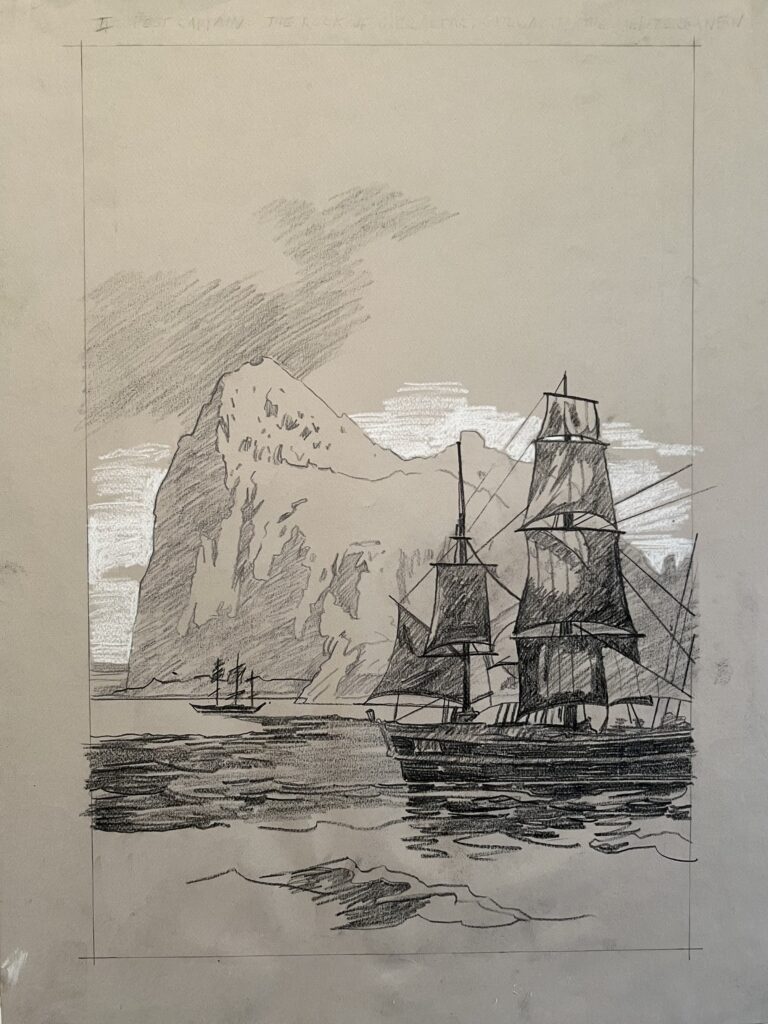
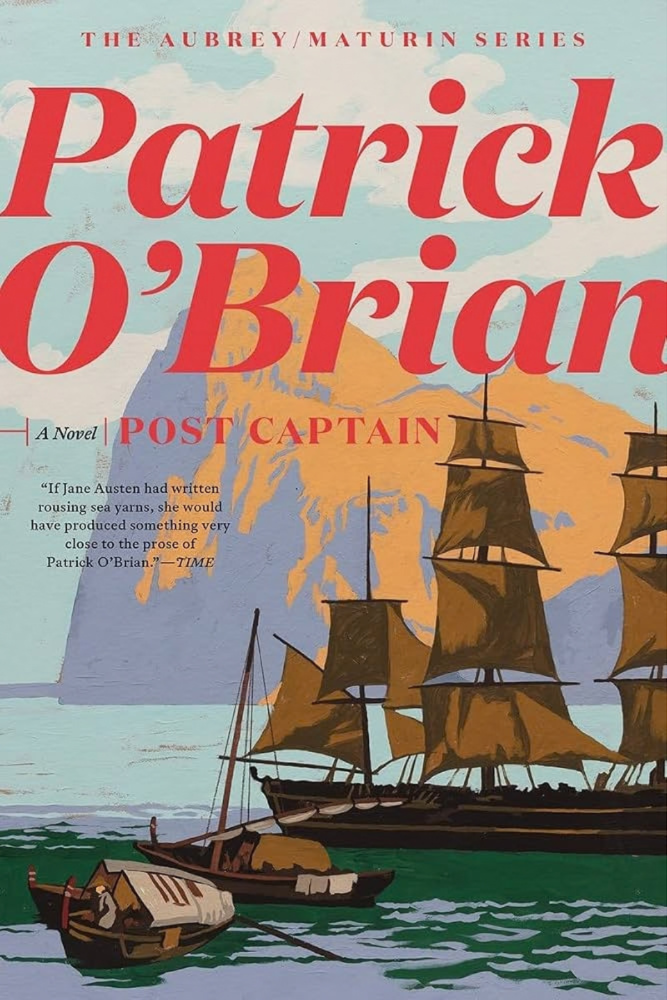
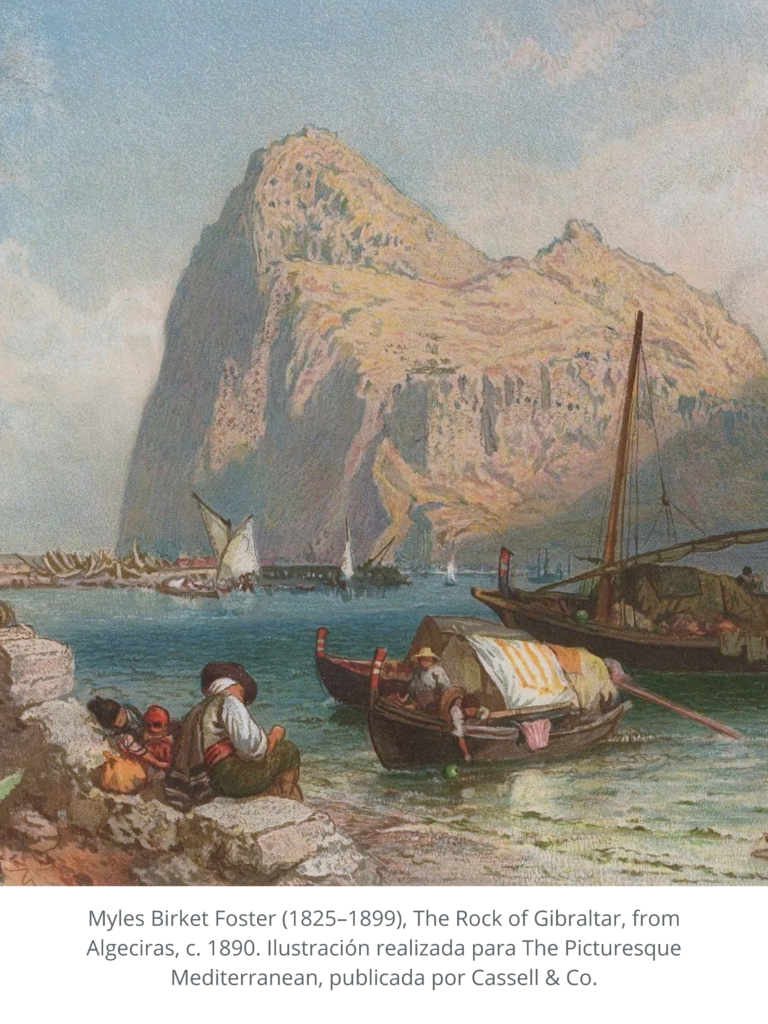
Ship in the Strait of Gibraltar
POST-CAPTAIN (Book II)
The cover of Post Captain, the second novel in the Aubrey–Maturin series, depicts the Rock of Gibraltar as seen from the entrance to the Mediterranean, as the protagonists, Jack Aubrey and Stephen Maturin, encounter it during their voyage.
Beyond its role in Patrick O’Brian’s novel, Gibraltar is one of the most strategically significant locations in British naval history. Under British control since the early eighteenth century, it became an important Royal Navy base during the Napoleonic Wars and a gateway to the Mediterranean, supporting British naval operations and the blockade of French and Spanish ports.
The imposing silhouette of the Rock that Matthew Benedict incorporates into the composition evokes a distinctive maritime landscape, familiar to sailors in the early nineteenth century. The ship passing through the Strait places the scene at one of the principal links between the Atlantic and the Mediterranean, at a time marked by intense naval activity among the European powers.
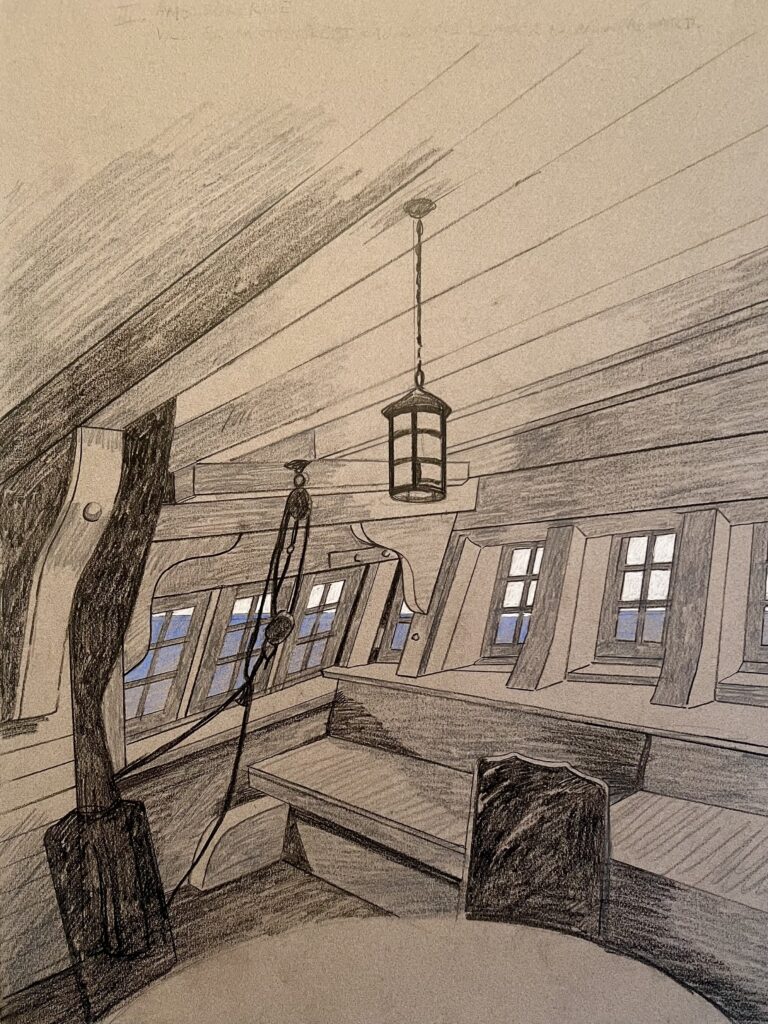
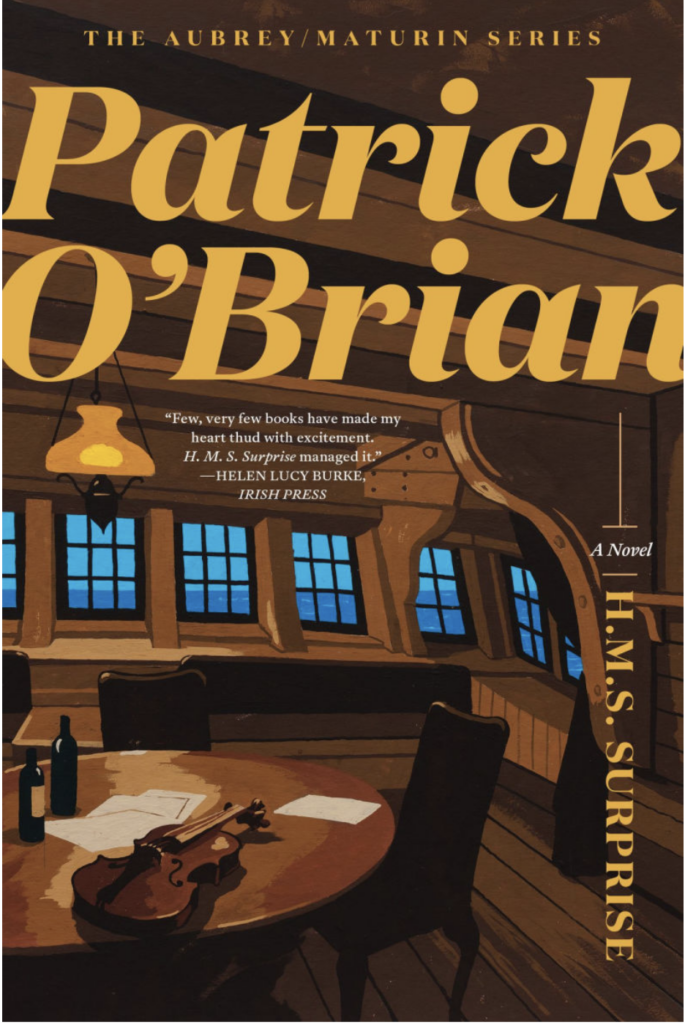
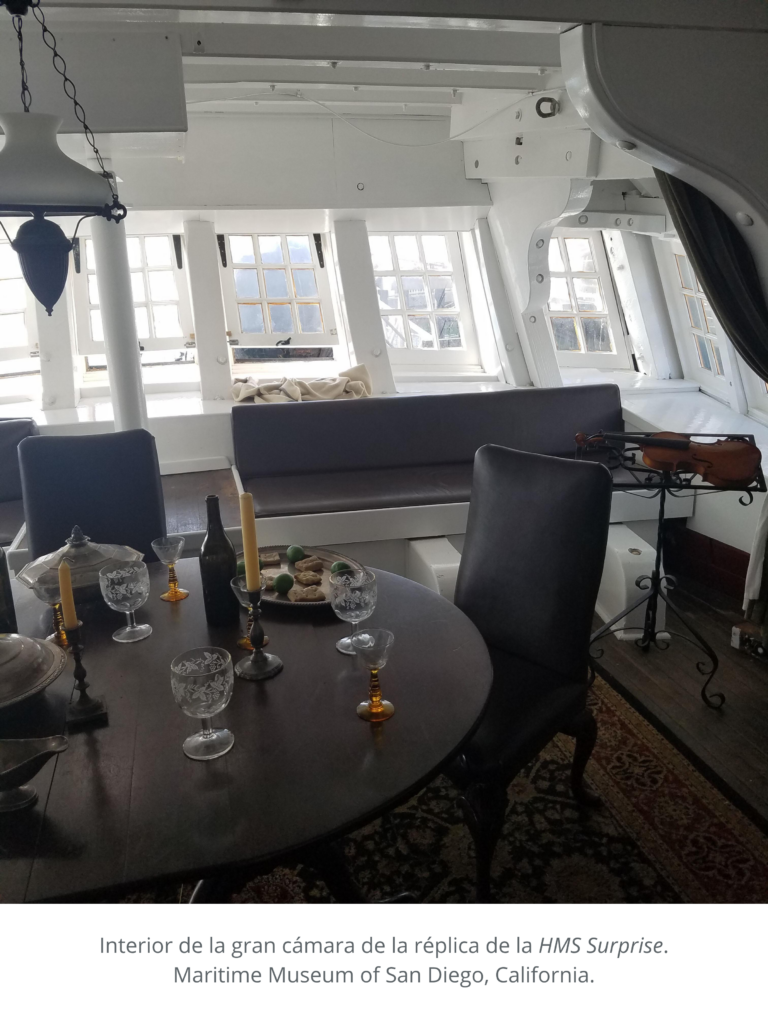
Blue Hour in the Great Cabin of the HMS Surprise
HMS SURPIRSE (Book III)
For this study, Benedict drew inspiration from the recreation of the great cabin aboard HMS Surprise used in the film Master and Commander: The Far Side of the World (2003), directed by Peter Weir. The ship’s interior was constructed for the film with particular attention to the atmosphere and details of an early nineteenth-century warship. The arrangement of the furniture, the wooden panelling, the windows, and the lighting provided the artist with a concrete reference for constructing this nocturnal scene.
The vessel used in the film was not the historical HMS Surprise either. It was a replica of HMS Rose, built in 1970 and later modified to portray the Surprise on screen. Benedict’s image therefore brings together several layers of representation: the historical ship that inspired O’Brian, the Surprise imagined in the novels, and its cinematic recreation, which the artist used as a visual reference.
The title Blue Hour refers to the distinctive bluish light of the scene. Contrasting with the warm glow of the lanterns, it creates an intimate, hushed atmosphere within the ship.
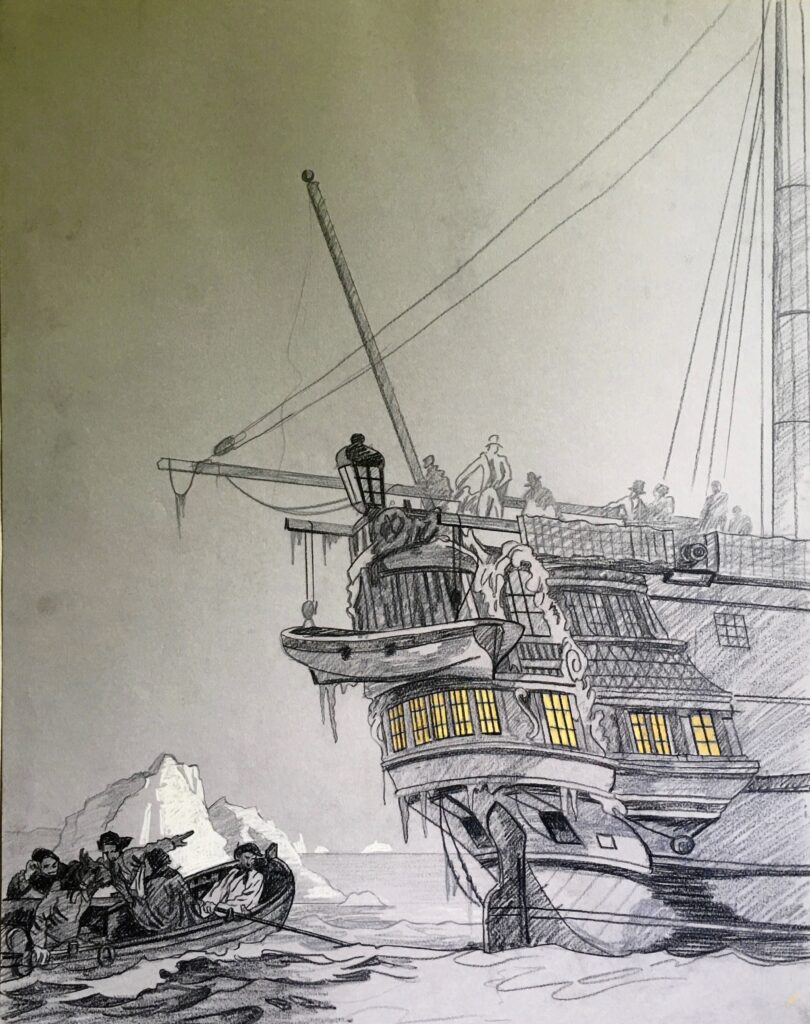
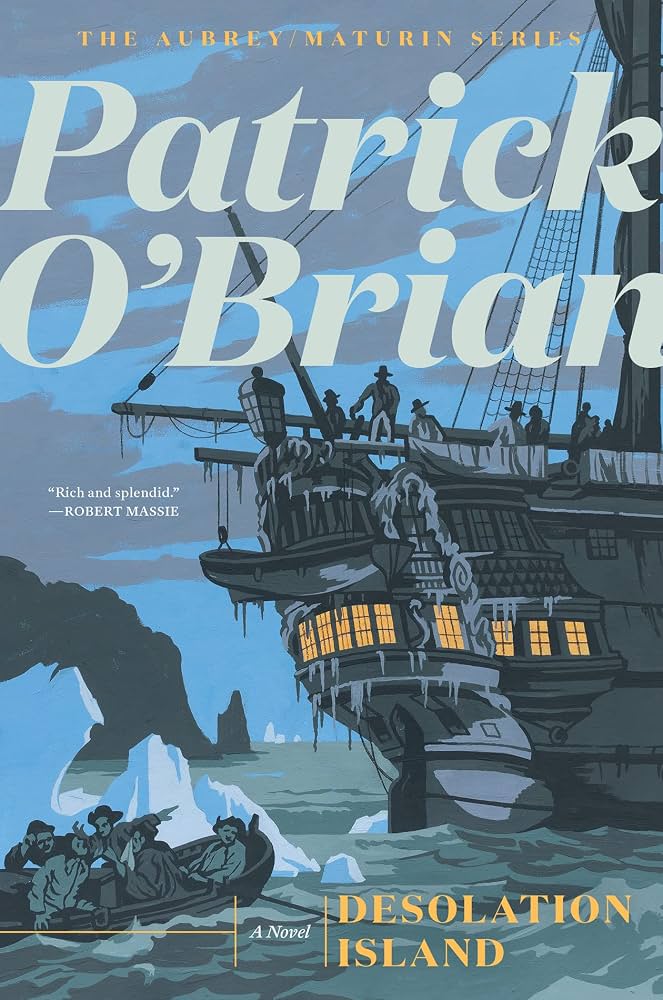
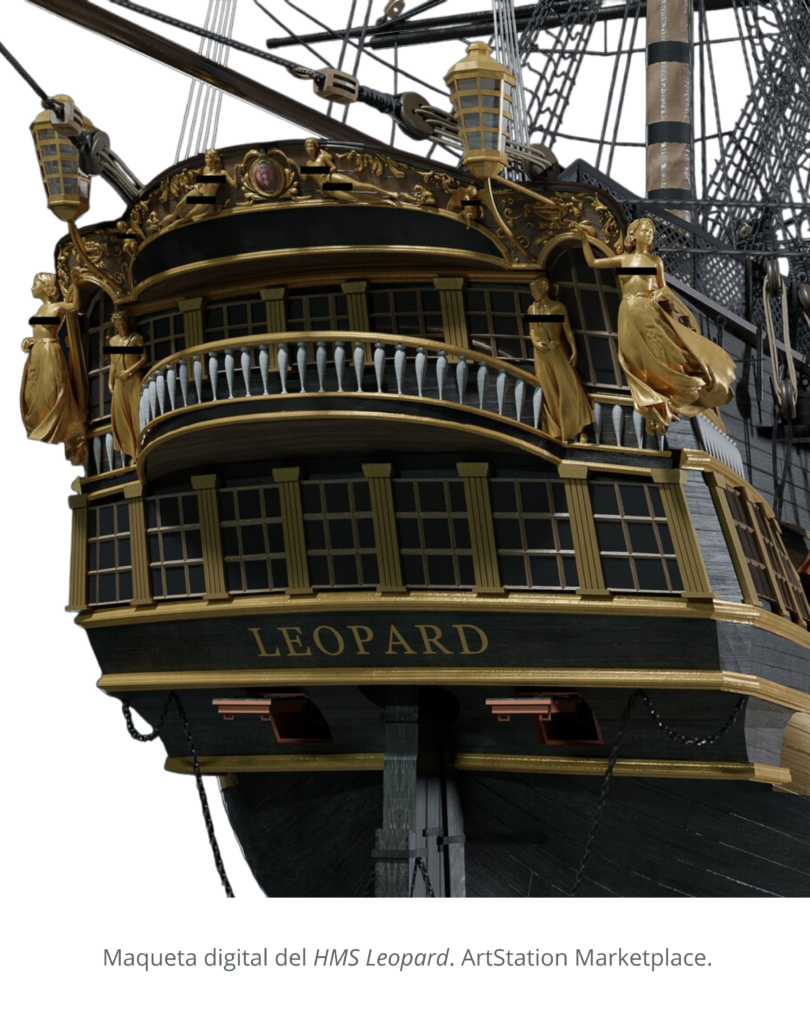
HMS Leopard in the Ice
DESOLATION ISLAND (Book V)
Launched in 1790, HMS Leopard was a 50-gun Royal Navy ship and one of the many historical vessels Patrick O’Brian incorporated into the fiction of the Aubrey–Maturin series. In Desolation Island, the fifth novel, the Leopard sails towards Australia through the frigid waters of the Southern Ocean, where it encounters an enormous iceberg that causes severe damage to its hull and rudder.
For this depiction, Matthew Benedict drew closely on contemporary naval engravings and drawings, reconstructing the appearance of the historical vessel and transposing it into the fictional scene described by O’Brian. Working from a specific historical ship allowed Benedict to achieve a level of precision that goes beyond literary imagination. The shape of the hull, the arrangement of the masts and rigging, and the various structural elements of the vessel all derive from the naval documentation the artist used to reconstruct the Leopard visually.
The encounter with the iceberg, however, belongs to O’Brian’s fictional world. Benedict thus combines two levels of representation: the reconstruction of a vessel that genuinely existed and the scene imagined by the writer in the remote waters of the Southern Ocean.
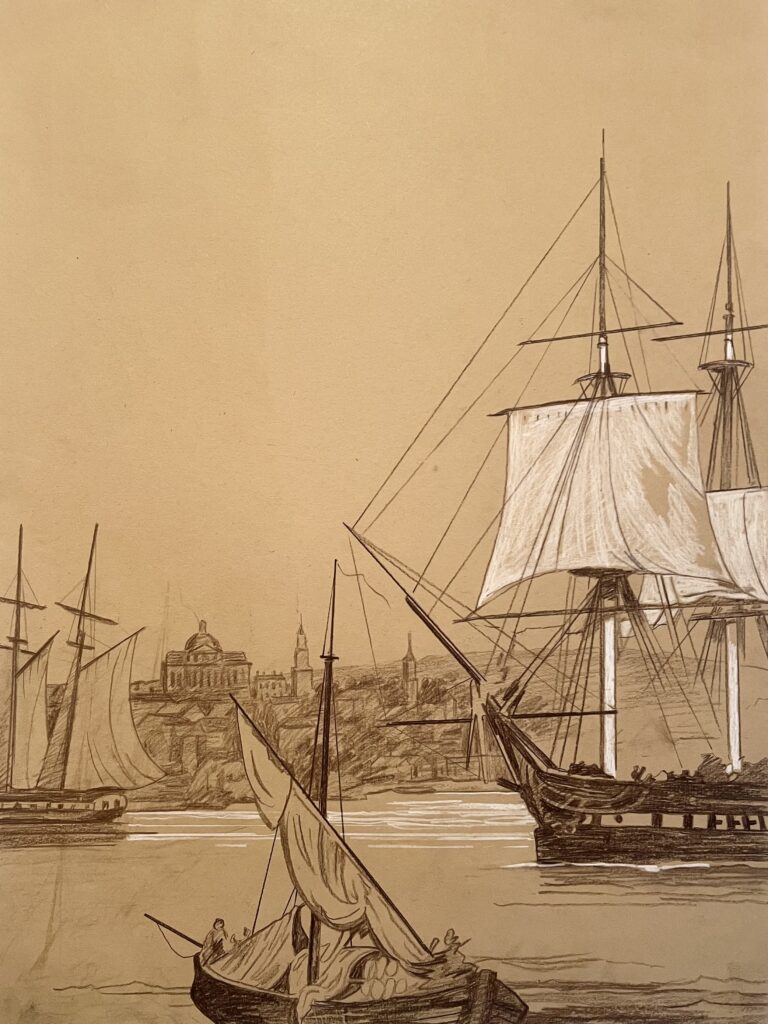
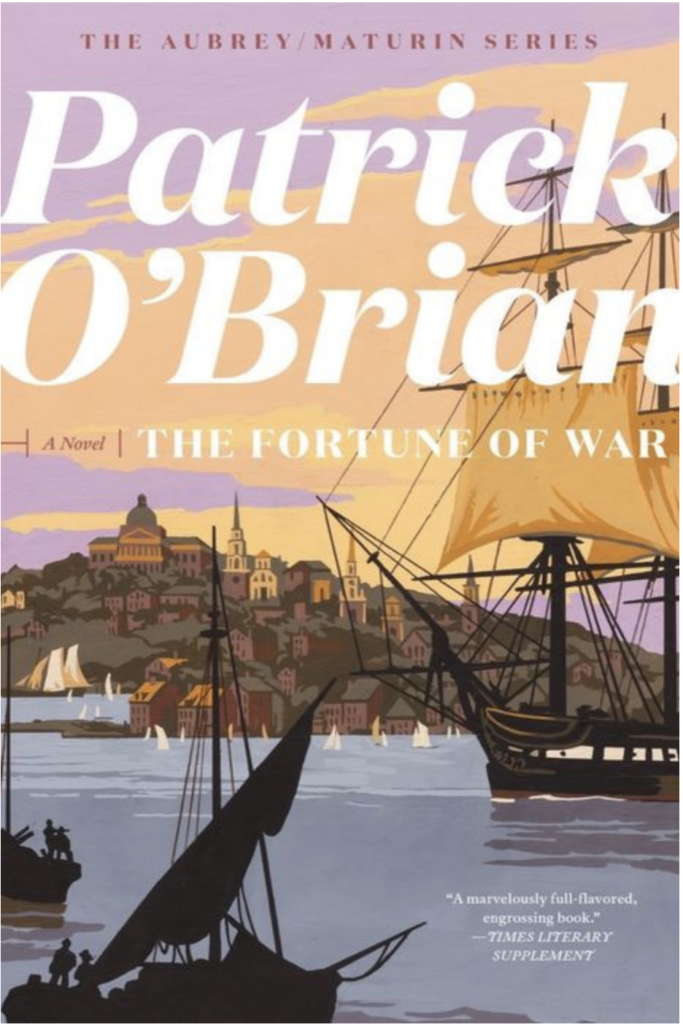
Boston Harbour, c. 1812
THE FORTUNE OF WAR (Book VI)
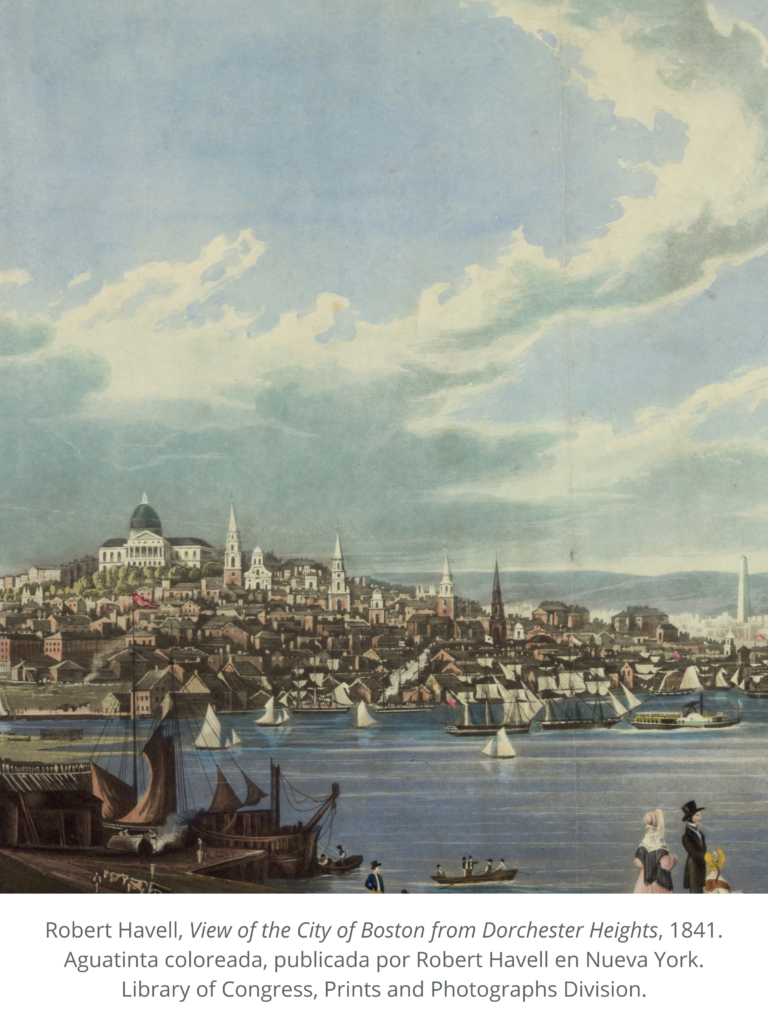
The sixth novel in the Aubrey–Maturin series, The Fortune of War, places Jack Aubrey and Stephen Maturin in Boston during the War of 1812, the conflict between the United States and Great Britain that lasted from 1812 to 1815. For the cover, Matthew Benedict depicts Boston Harbour around 1812, with its maritime landscape and urban skyline. Among its most recognisable landmarks are the dome of the Massachusetts State House, the spire of Park Street Church, and the dome of Faneuil Hall.
Boston Harbour was one of New England’s principal commercial and maritime centres and acquired particular importance during the conflict. The war profoundly disrupted shipping and trade along the American Atlantic coast, while the Royal Navy sought to restrict communications and maritime traffic at North American ports.
To reconstruct this urban landscape, Benedict turned to historical visual sources that helped him establish what Boston looked like in the early decades of the nineteenth century. These included View of the City of Boston from Dorchester Heights, a view of the city made by Robert Havell in 1841, offering a sweeping panorama of the harbour and its skyline.
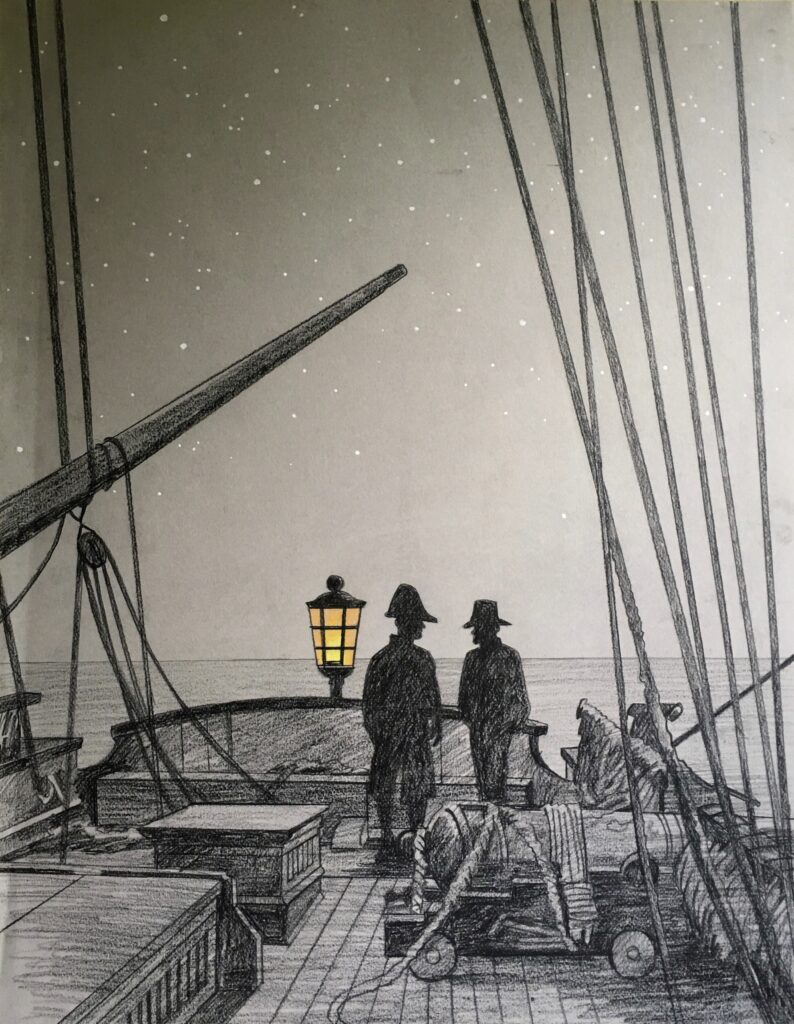
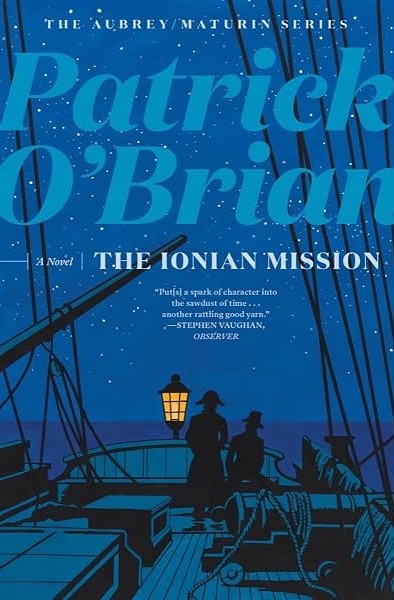
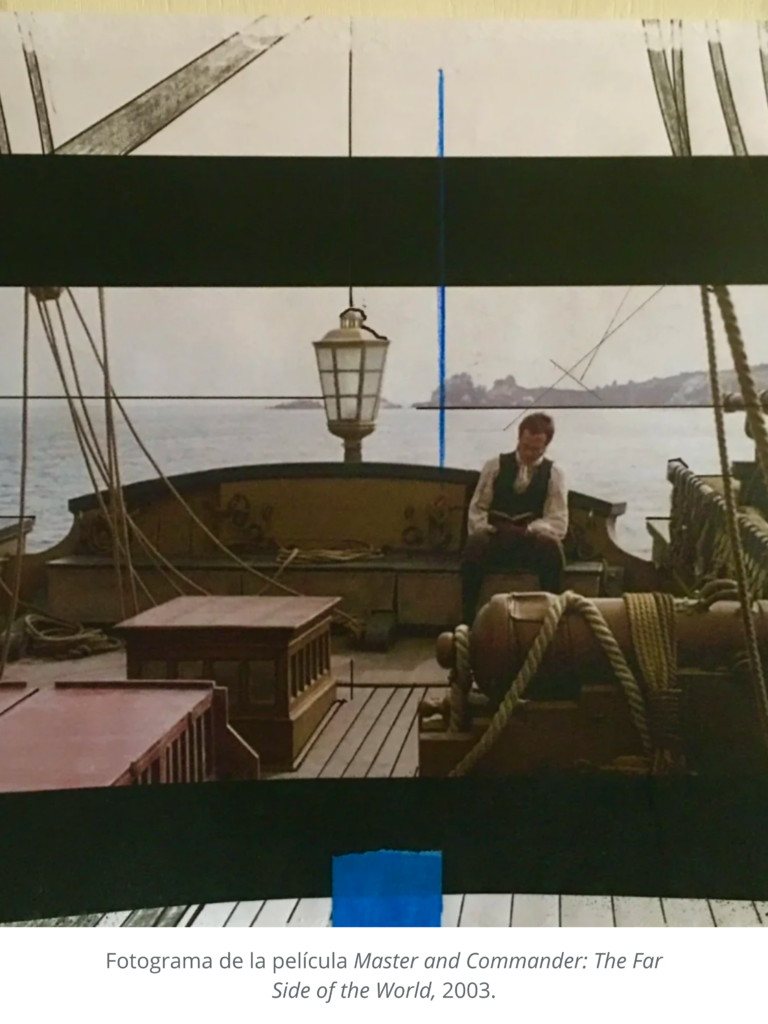
Captain Guldilocks and Doctor Maturin on the quarterdeck of the HMS Surprise
THE IONIAN MISSION (Book VIII)
The eighth novel in the Aubrey–Maturin series, The Ionian Mission, takes place in the eastern Mediterranean during the Napoleonic Wars, when the Ionian Islands held considerable strategic importance. For this illustration, Matthew Benedict depicts the protagonists, Jack Aubrey and Stephen Maturin, on the quarterdeck of HMS Surprise, on a night illuminated by the stars and a single lantern.
The cinematic reference used by Benedict adds another layer to his reconstruction of HMS Surprise. The ship featured in Master and Commander: The Far Side of the World (2003) was not the historical vessel that inspired O’Brian, but a replica of HMS Rose, built in 1970 and adapted for its role in the film. This recreation provided Benedict with a concrete visual reference for the structure of the deck, the rigging, and the ship’s overall appearance.
The study brings together several layers of representation: the historical Surprise that inspired O’Brian, the vessel imagined in his novels, and its cinematic recreation, which served as the artist’s visual reference.
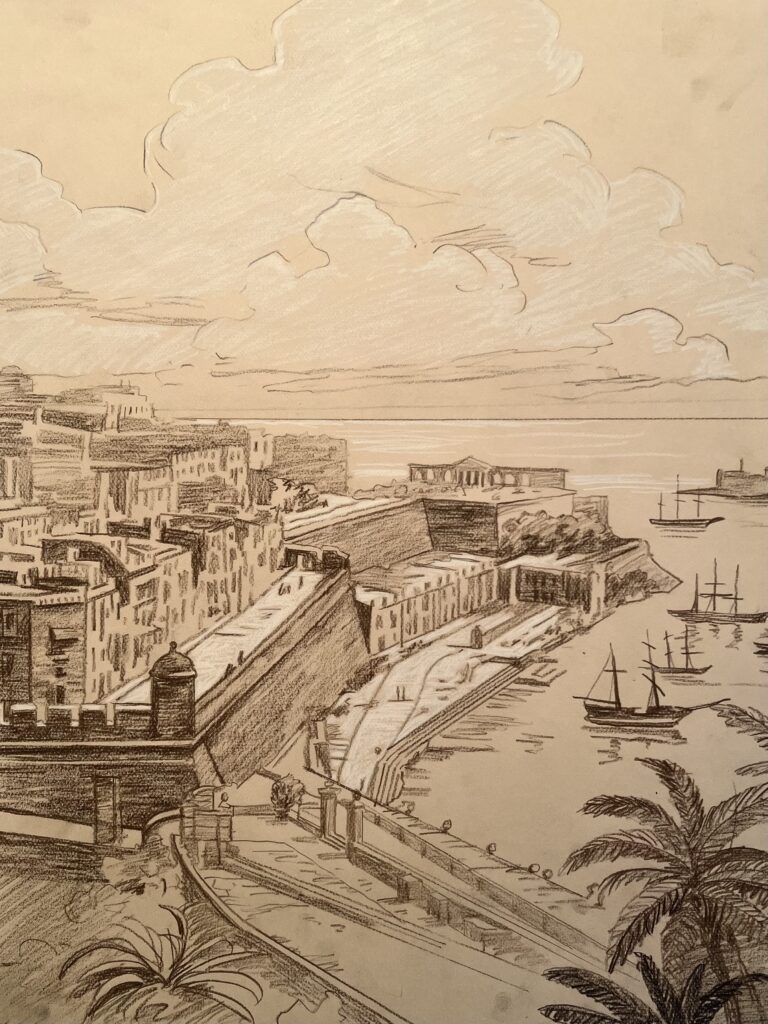
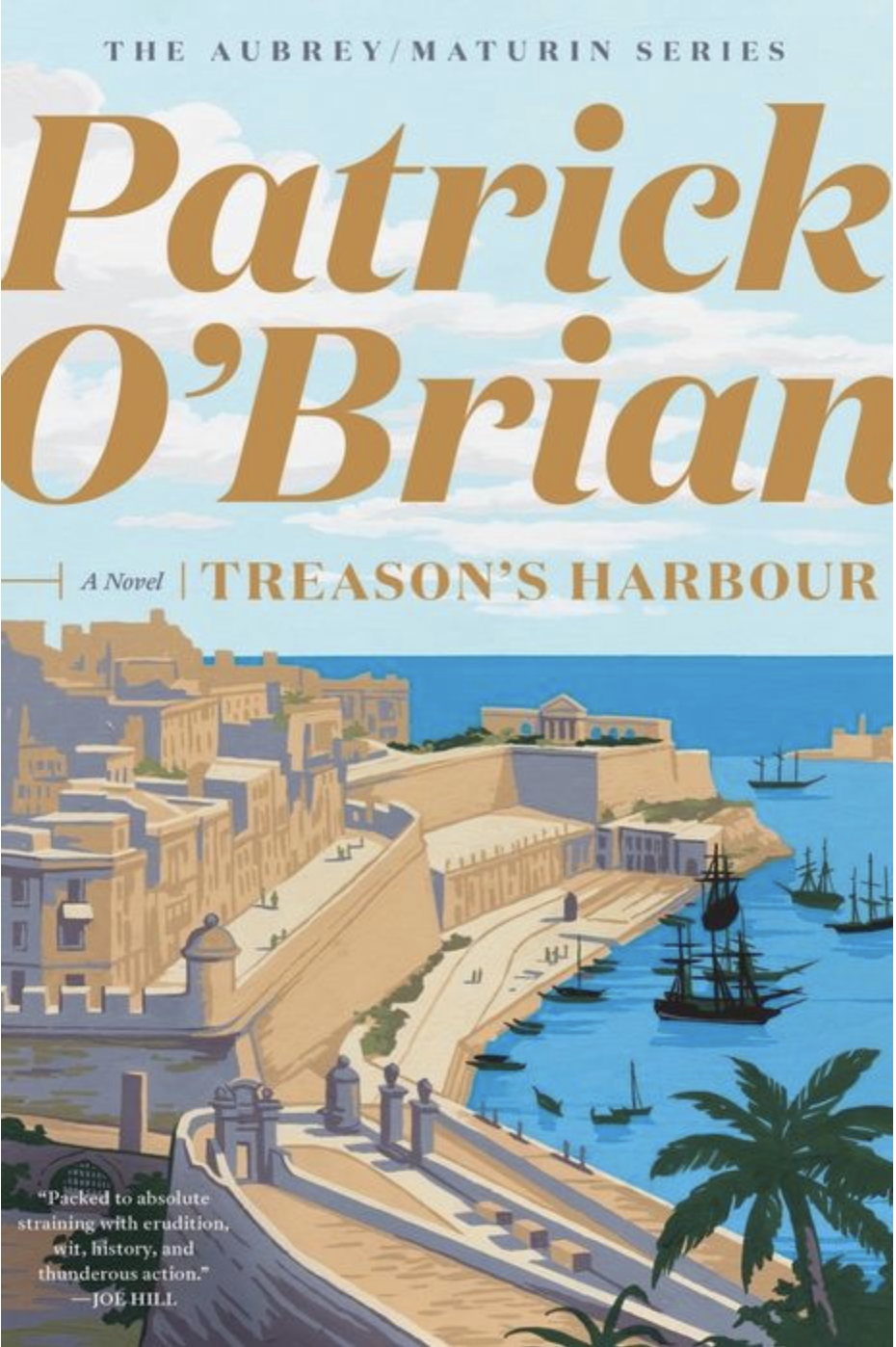
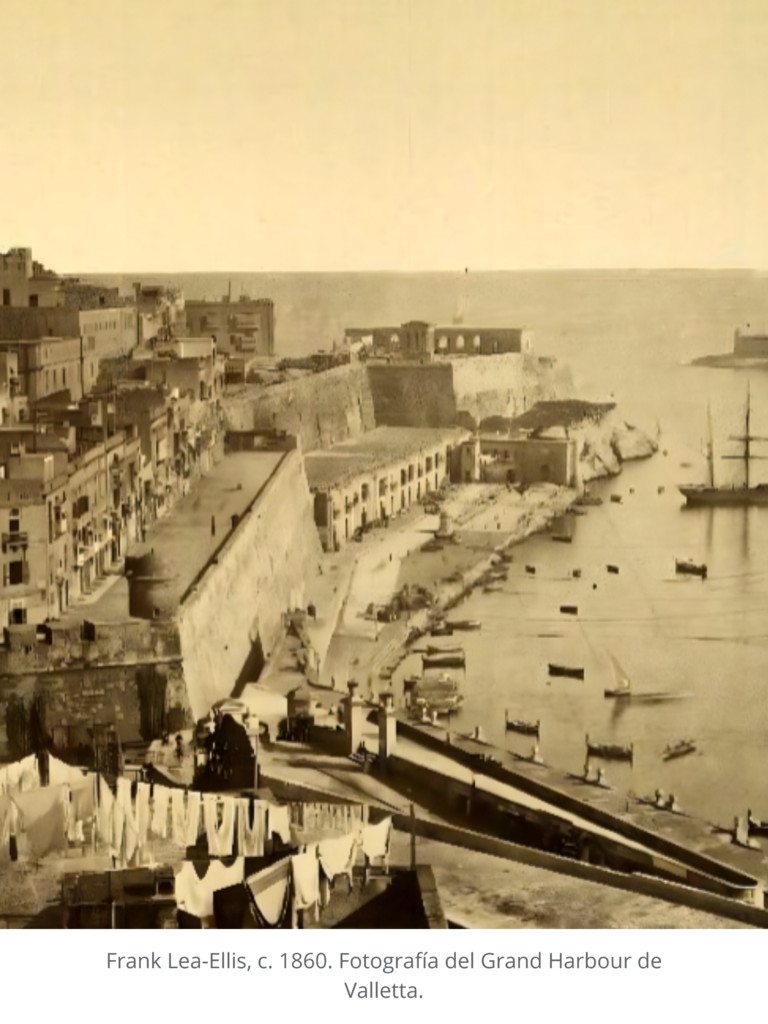
Grand Harbour, Valletta, Malta, c. 1812
TREASON’S HARBOUR (Book IX)
The ninth novel in the Aubrey–Maturin series, Treason’s Harbour, is set primarily in Malta in 1812, when the island was under British rule. For the cover, Matthew Benedict depicts Valletta’s Grand Harbour, one of the Mediterranean’s principal naval strongholds, with the city’s imposing fortifications rising in the background.
Malta came under British control in 1800 and, during the early decades of the nineteenth century, Grand Harbour developed into an important Royal Navy base. Its strategic position in the Mediterranean, the natural protection offered by the harbour, and the extensive system of surrounding fortifications made Valletta a key location for British naval operations.
Benedict’s scene reconstructs this early nineteenth-century harbour landscape, where the vessels, the port, and Valletta’s defensive walls form an inseparable part of Malta’s naval history. By choosing a real location of major strategic importance to the Royal Navy, Benedict anchors O’Brian’s fiction in a specific historical landscape. The image does more than illustrate a scene from the novel: it seeks to reconstruct the appearance of the Maltese harbour during the Napoleonic Wars.
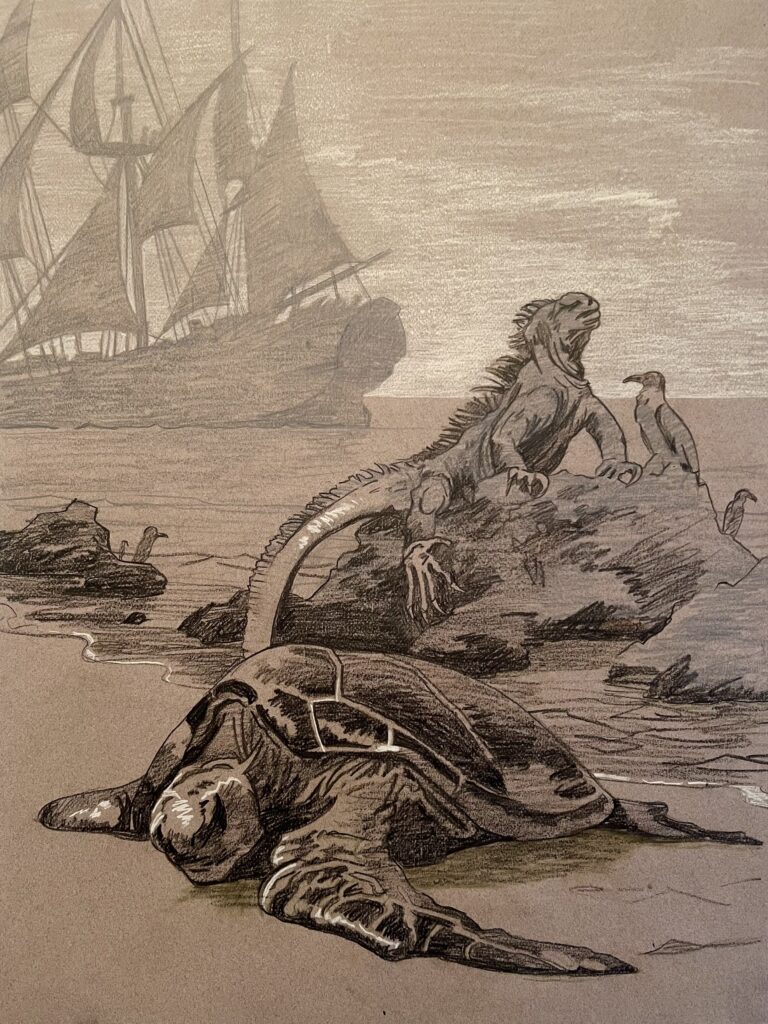
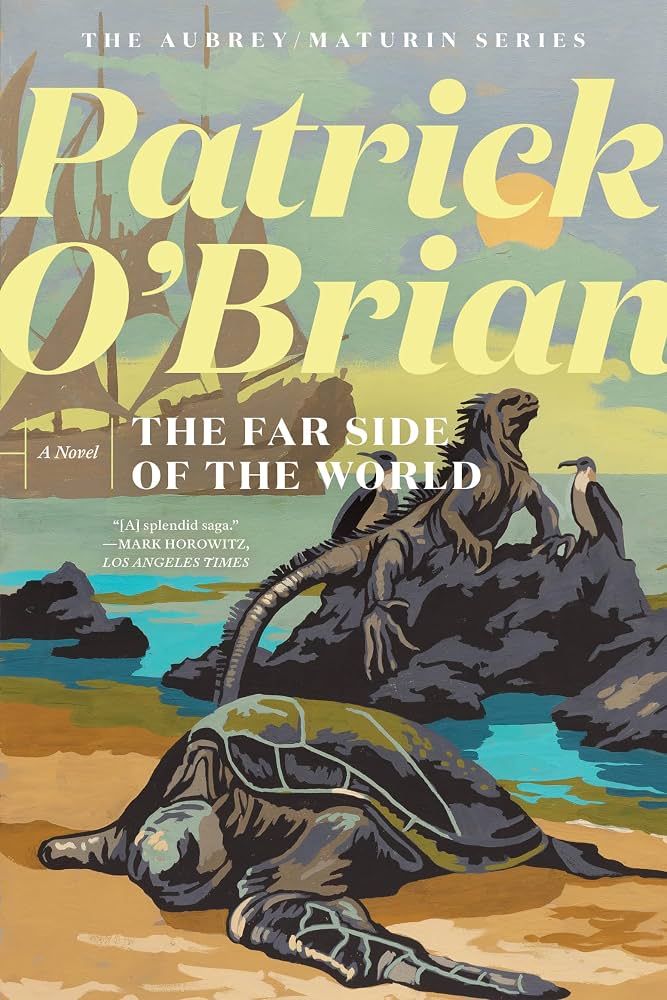
HMS Surprise Reaches the Galapagos
THE FAR SIDE OF THE WORLD (Book X)
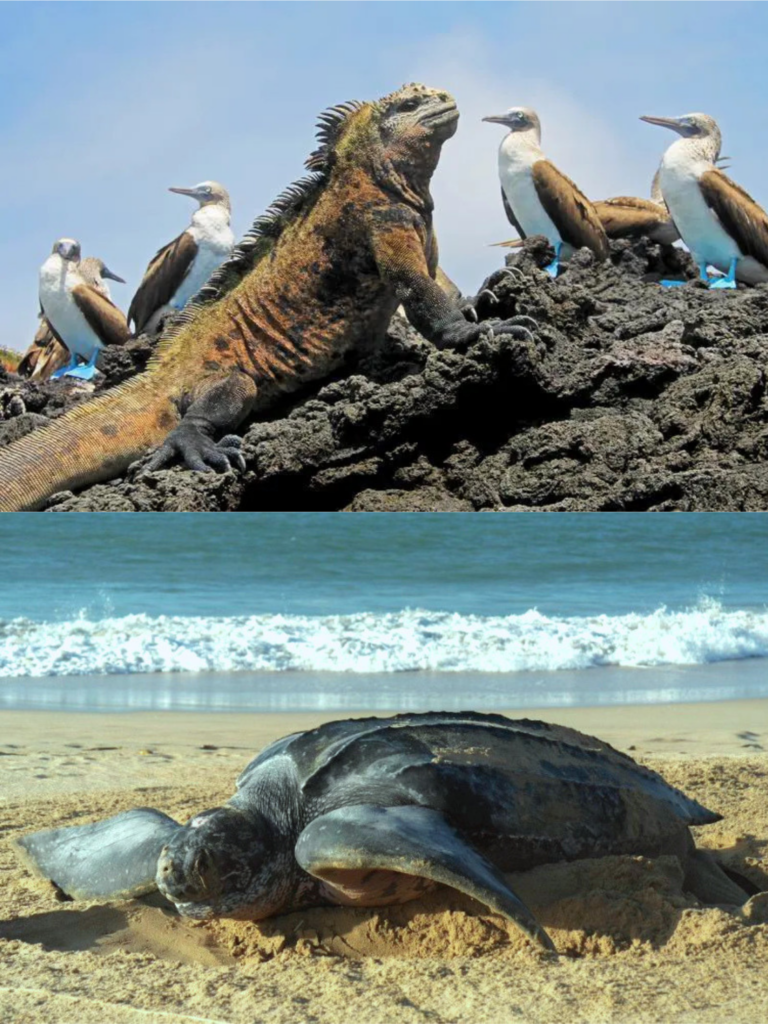
The tenth novel in the Aubrey–Maturin series, The Far Side of the World, takes Jack Aubrey and Stephen Maturin to the Galapagos Islands. In this illustration, Matthew Benedict centres the composition on three of the archipelago’s most characteristic animals: a giant tortoise, a marine iguana, and a blue-footed booby. In the background appears HMS Surprise, the ship around which much of the series unfolds.
The juxtaposition of the vessel and this distinctive wildlife captures one of the novel’s central themes: the encounter between seafaring and the exploration of the natural world. To depict the animals, Benedict drew on contemporary photographic references of the archipelago’s fauna. One of these shows marine iguanas and blue-footed boobies together, providing a direct reference for the arrangement and appearance of the animals in the study.
The ship in the background introduces a second layer of references. Although O’Brian’s HMS Surprise was inspired by the French corvette Unité, Benedict used the vessel featured in Master and Commander: The Far Side of the World (2003) as his visual reference. The image thus brings together three levels of representation: the historical Surprise that inspired O’Brian, the fictional ship in the novels, and its cinematic recreation.
The Gifts of Samuel Panda
THE REVERSE OF THE MEDAL (Book XI)
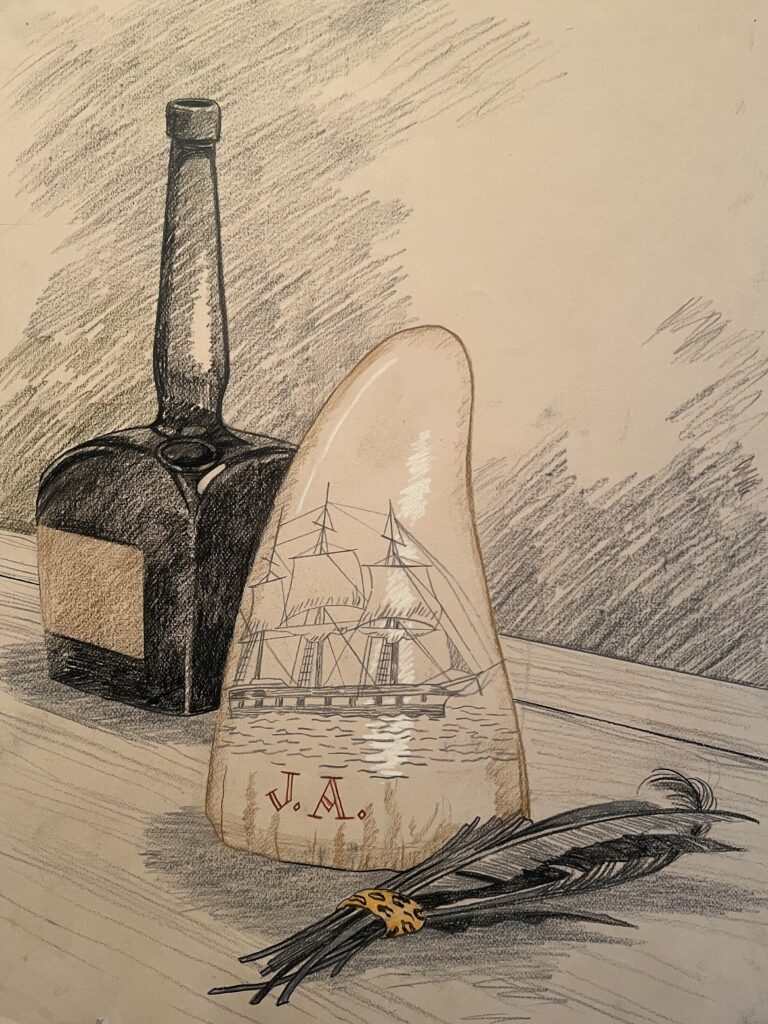
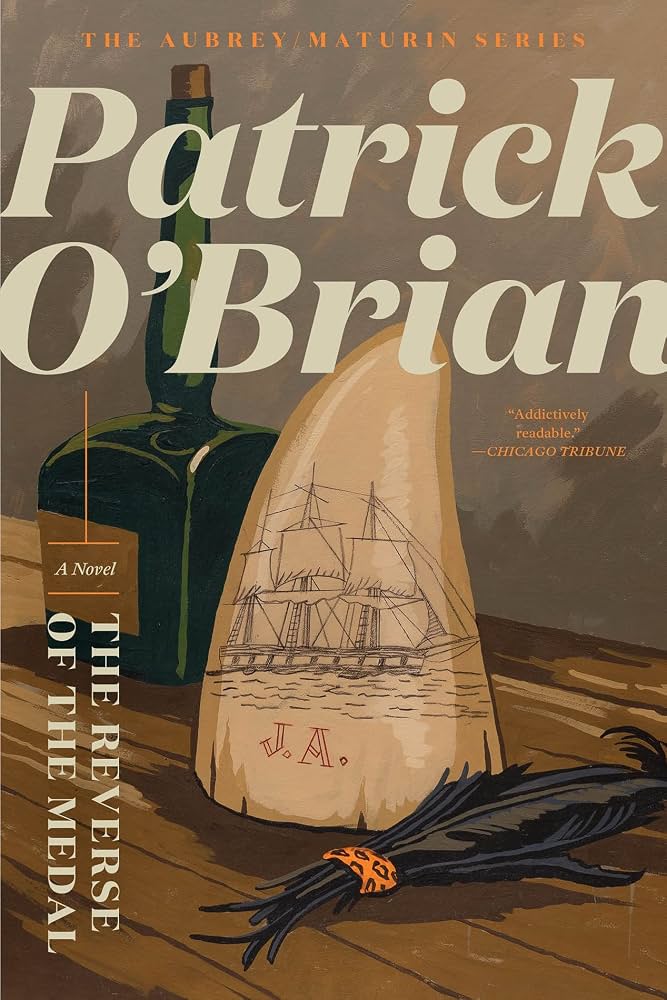
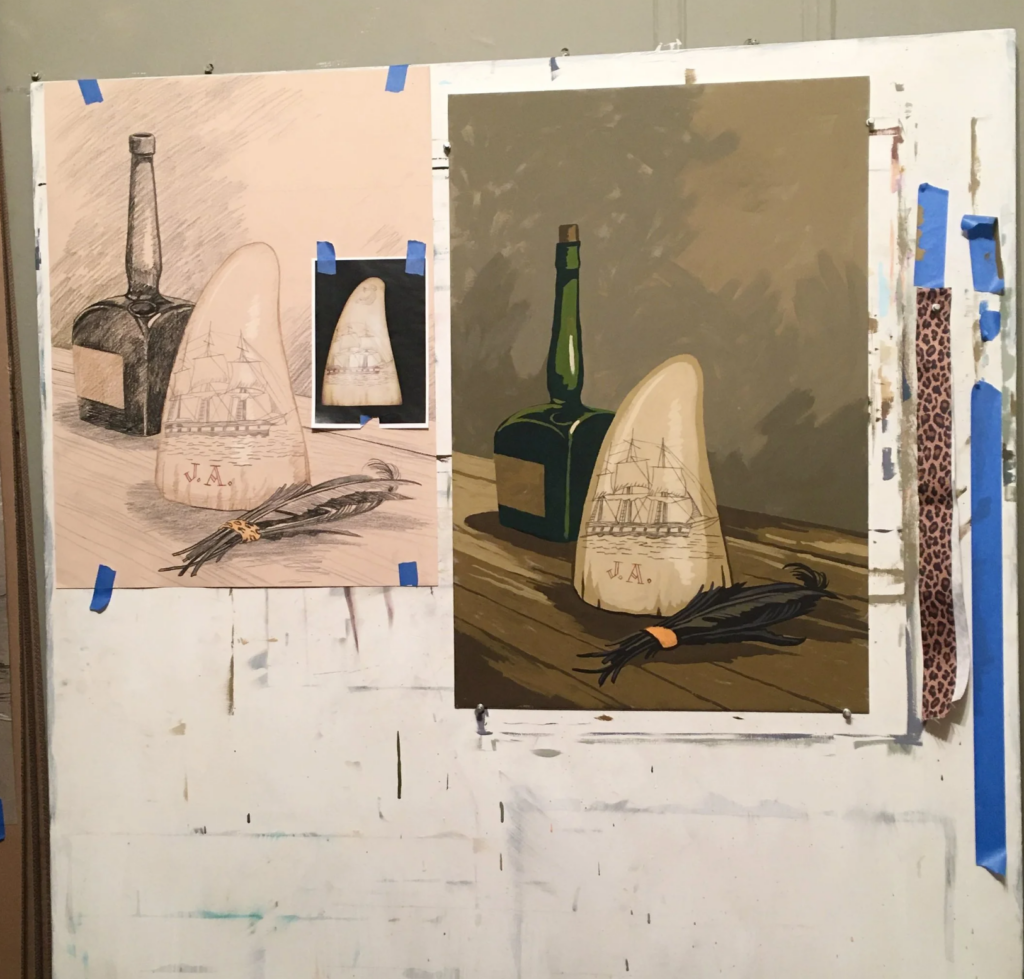
In The Reverse of the Medal, the eleventh novel in the Aubrey–Maturin series, Jack Aubrey meets Samuel M’Puta, his illegitimate son, for the first time. Samuel was born from Aubrey’s relationship with an African woman. Samuel brings two gifts for his father: a sperm whale tooth carved by Jack and left behind in Africa, depicting the first ship on which he served; and a protective amulet against drowning, made by Samuel’s mother from feathers and elephant hair bound together with a strip of leopard skin.
Matthew Benedict recreates both objects from Patrick O’Brian’s descriptions. The tooth is decorated using the technique known as scrimshaw, a form of engraving practised by sailors and whalers during the eighteenth and nineteenth centuries. The amulet, assembled from animal materials, likewise follows O’Brian’s description of the object in the novel. The composition is completed by a bottle of port, based on a period example. In the scene, Jack produces the bottle to celebrate his reunion with his son.
The drawing offers a visual interpretation of an episode in the novel, in which the scrimshaw, the amulet, and the bottle bring together Jack’s memories, his encounter with Samuel, and the material culture associated with maritime life during the period.
HMS Diane Marooned in Indonesia
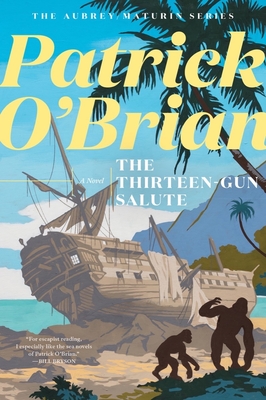
THE THIRTEEN-GUN SALUTE (Book XIII)
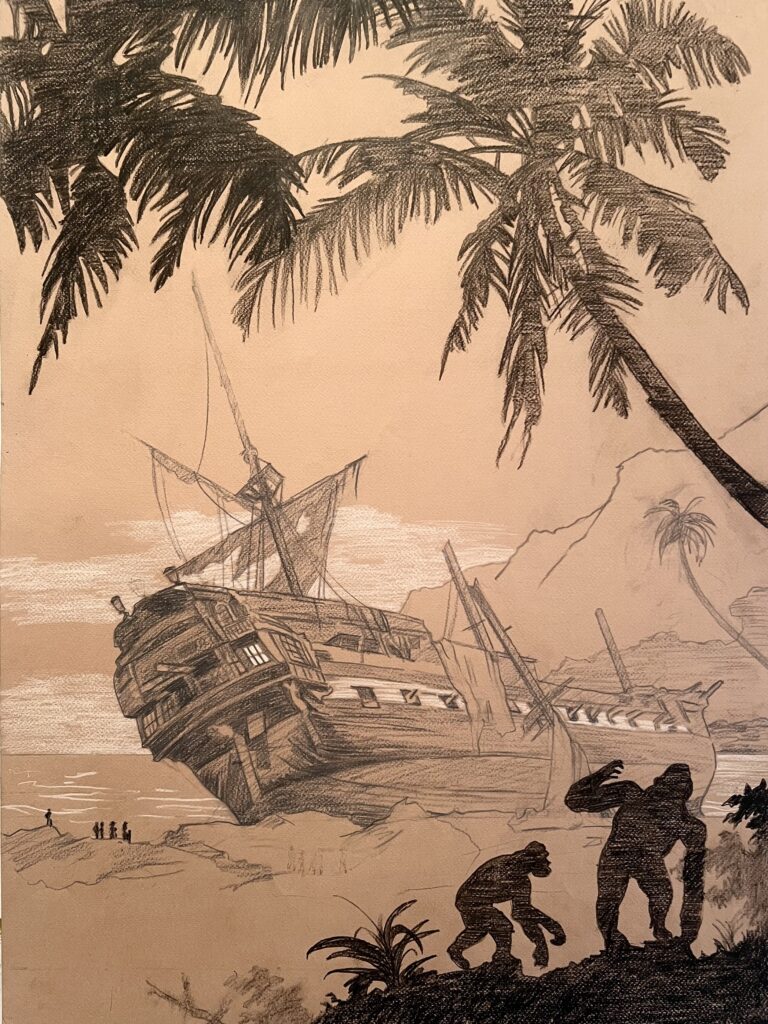
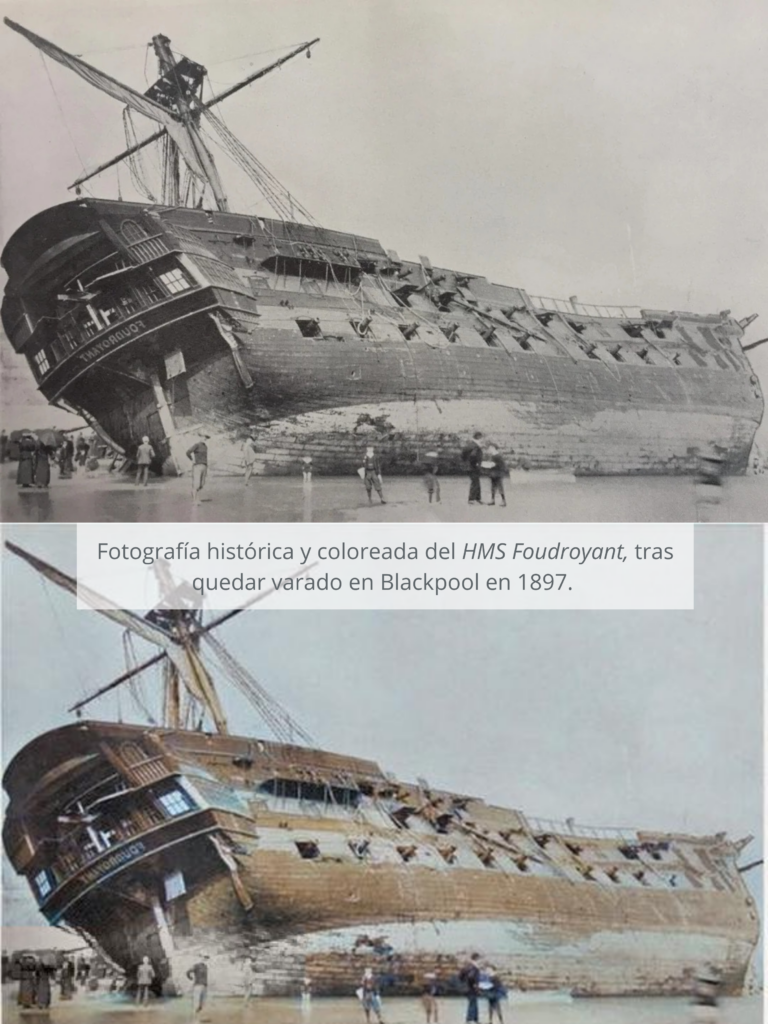
This preparatory study depicts O’Brian’s HMS Diane after it runs aground on an uncharted reef while returning towards Batavia in The Thirteen-Gun Salute, the thirteenth novel in the series. Unable to refloat the vessel, the crew abandons ship and becomes stranded on a nearby island while awaiting rescue. The episode draws on the historical loss of HMS Alceste, which ran aground on a reef in the Gaspar Strait in 1817 while on a mission in the East Indies.
The composition also includes two orangutans, connected to Stephen Maturin’s stay in Kumai, a valley situated in the crater of a volcano that the naturalist climbs to study the animals. There, he meets Muong, an orangutan raised by the monk Ananda. Benedict brings together different elements of the novel and the historical documentation underpinning it within a single composition.
To depict the shipwreck, Matthew Benedict also drew on a specific visual reference: images of HMS Foudroyant after it ran aground at Blackpool in 1897. The position of the hull and rigging in the drawing echoes this reference, transferring an actual nineteenth-century image to the fictional scene involving the Diane.
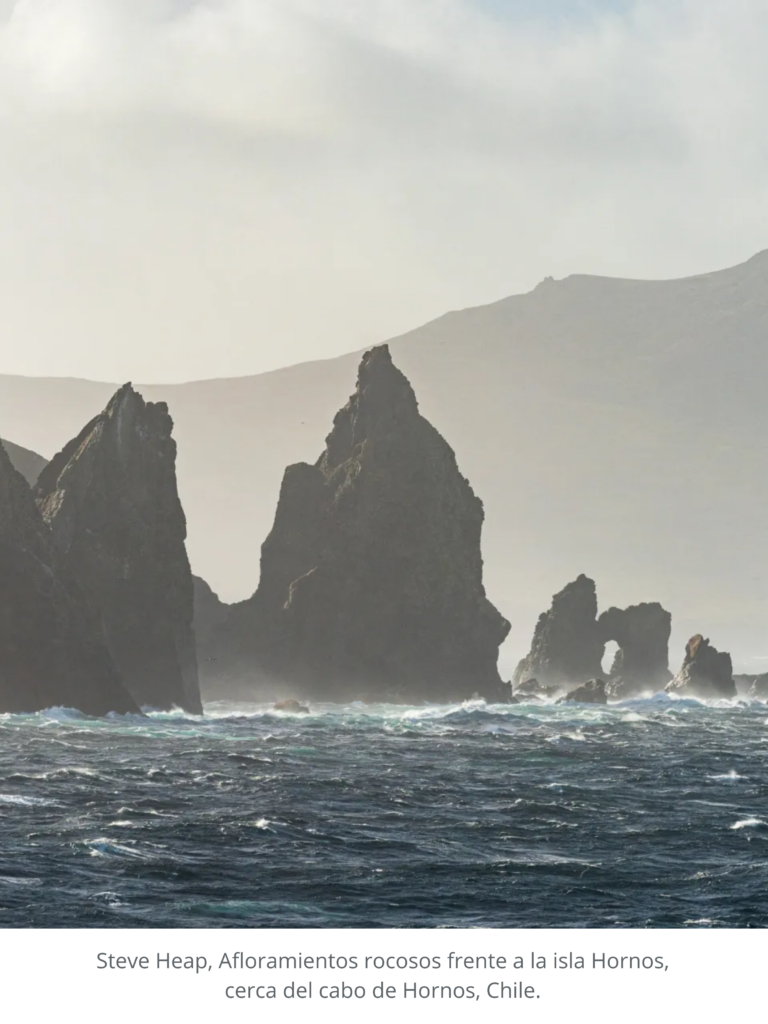
Cabo de Hornos
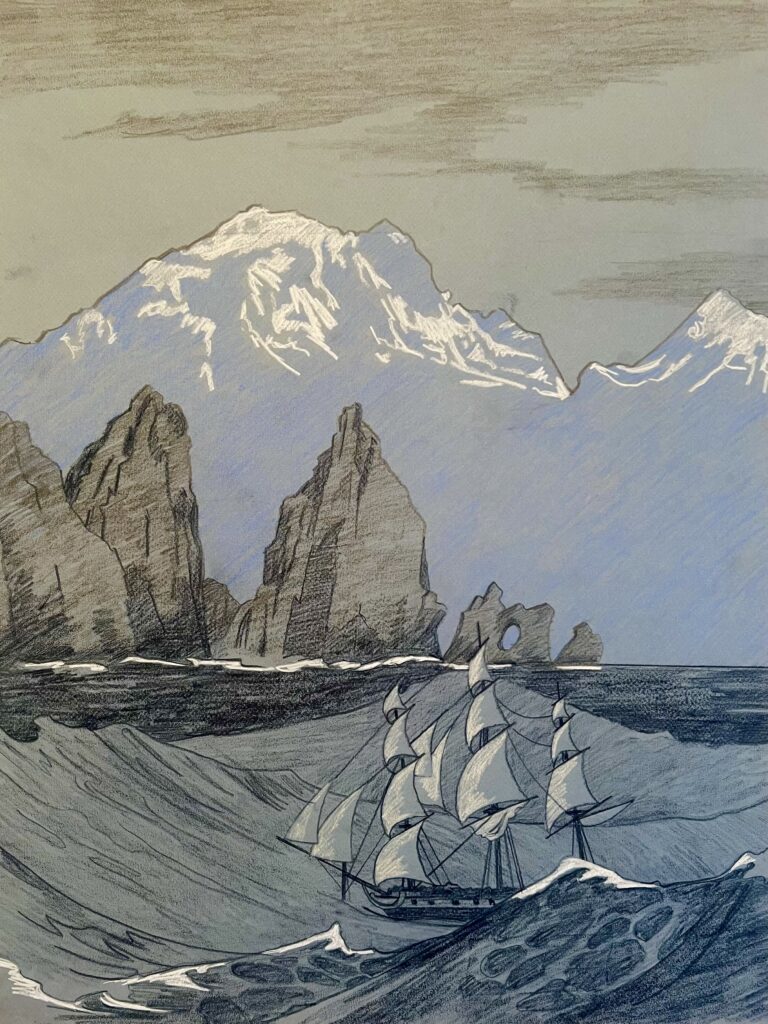
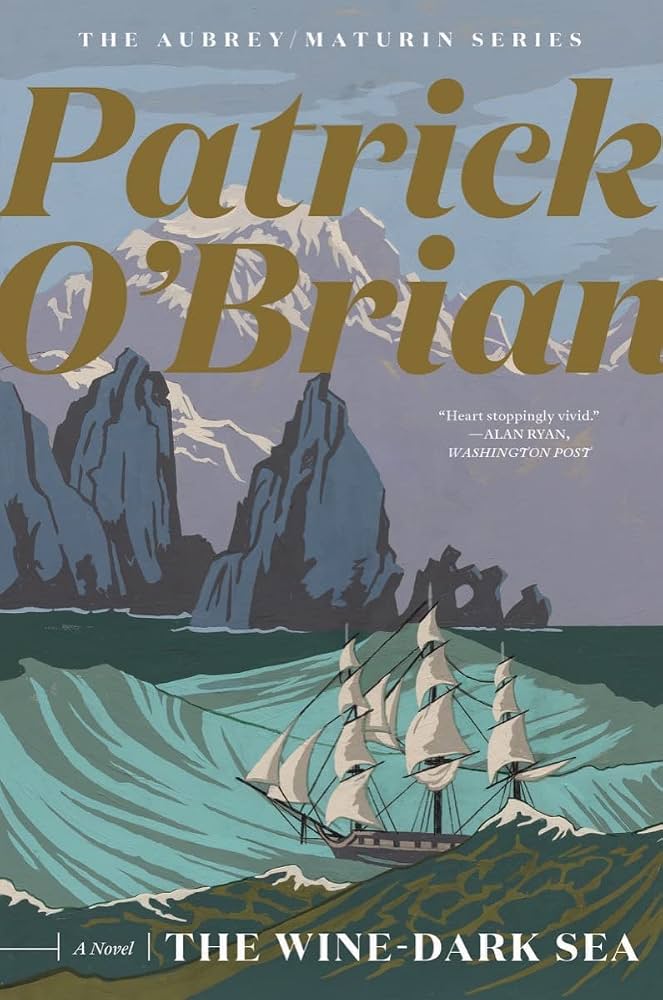
THE WINE-DARK SEA (Book XVI)
This preparatory study depicts a scene from The Wine-Dark Sea, the sixteenth novel in the Aubrey–Maturin series, as HMS Surprise sails off Cape Horn. Benedict places the ship in open, turbulent waters, with the distinctive rocky pinnacles of the southern coast of Hornos Island in view and the mountainous contours of the cape rising in the background. The island’s rugged, rocky coastline reaches heights of approximately 425 metres in this area and forms one of the most recognisable landscapes encountered when sailing around the cape.
Benedict’s choice of these features reflects his careful reconstruction of the novel’s geographical setting through real locations. Rather than depicting a generic maritime landscape, he identifies and translates into the drawing specific rock formations along the coast of Hornos Island, recognisable from the sea. The study demonstrates how geographical research becomes an integral part of the visual construction of O’Brian’s scenes.
To depict the ship, Benedict used the replica of HMS Rose featured in Master and Commander: The Far Side of the World (2003), which was adapted to portray HMS Surprise.
Battle with a Slaver
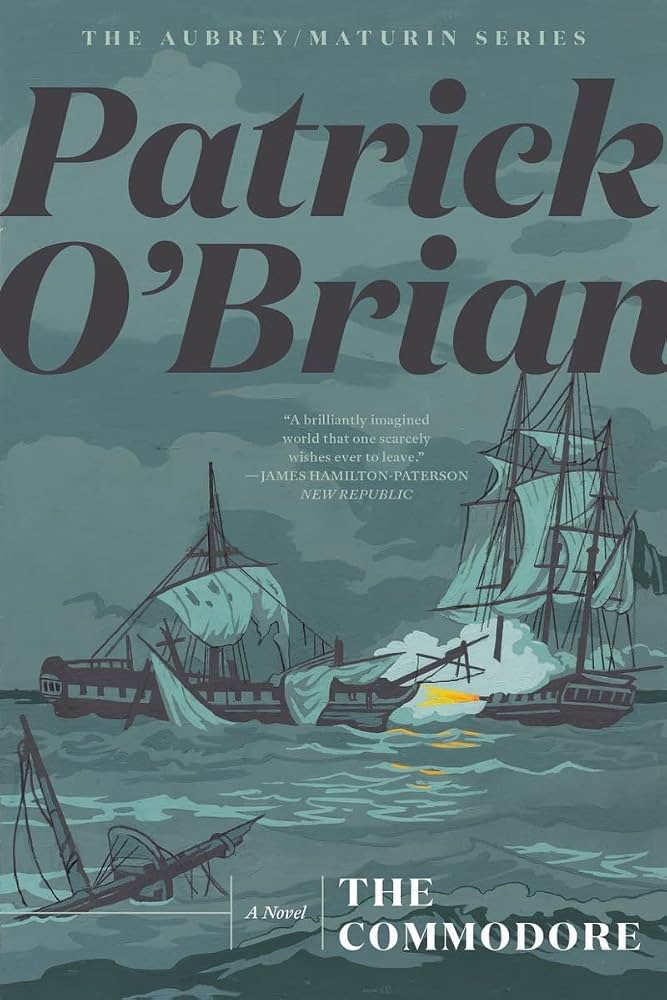
THE COMMODORE (Book XVII)
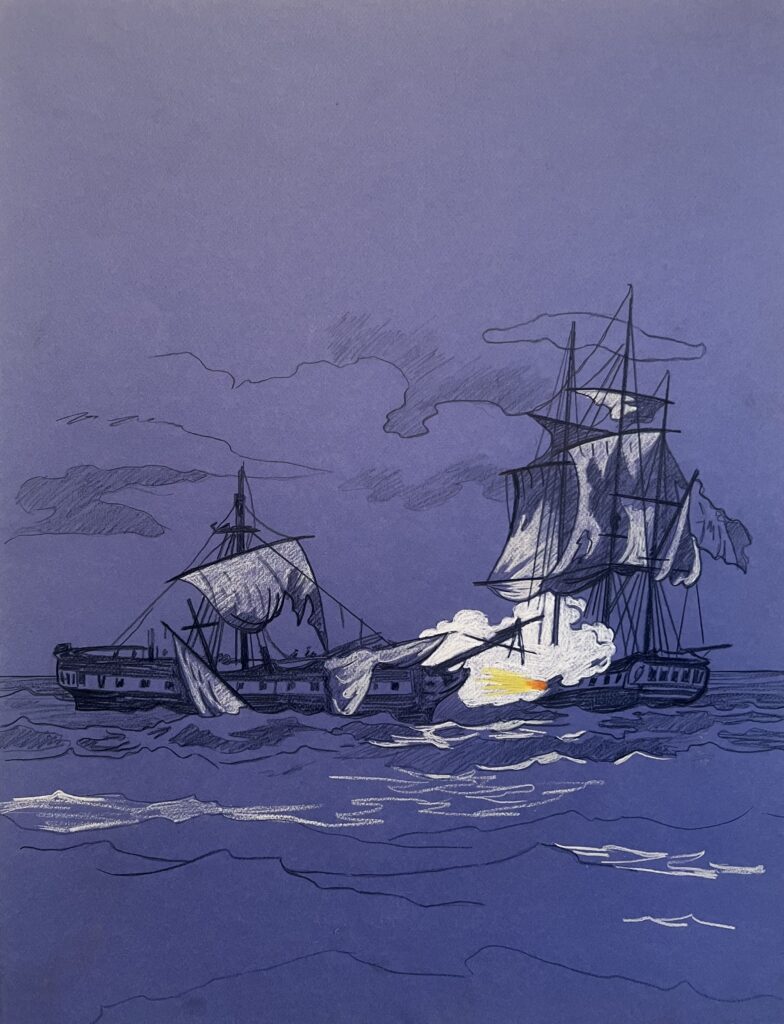
In The Commodore, the seventeenth novel in the Aubrey–Maturin series, Jack Aubrey is stationed off the west coast of Africa, commanding a Royal Navy squadron tasked with combating the slave trade. The action takes place around 1812, a few years after Britain abolished the slave trade in 1807. For this illustration, Matthew Benedict depicts one of the campaign’s naval engagements, with HMS Bellona, Aubrey’s flagship, confronting a slave ship.
Although the historical Bellona did not take part in the anti-slavery operations depicted in the novel, the broader context is historical. Following the British abolition of the slave trade in 1807, the Royal Navy began deploying vessels along the west coast of Africa to intercept ships involved in the trade, making these operations a new responsibility for the British navy.
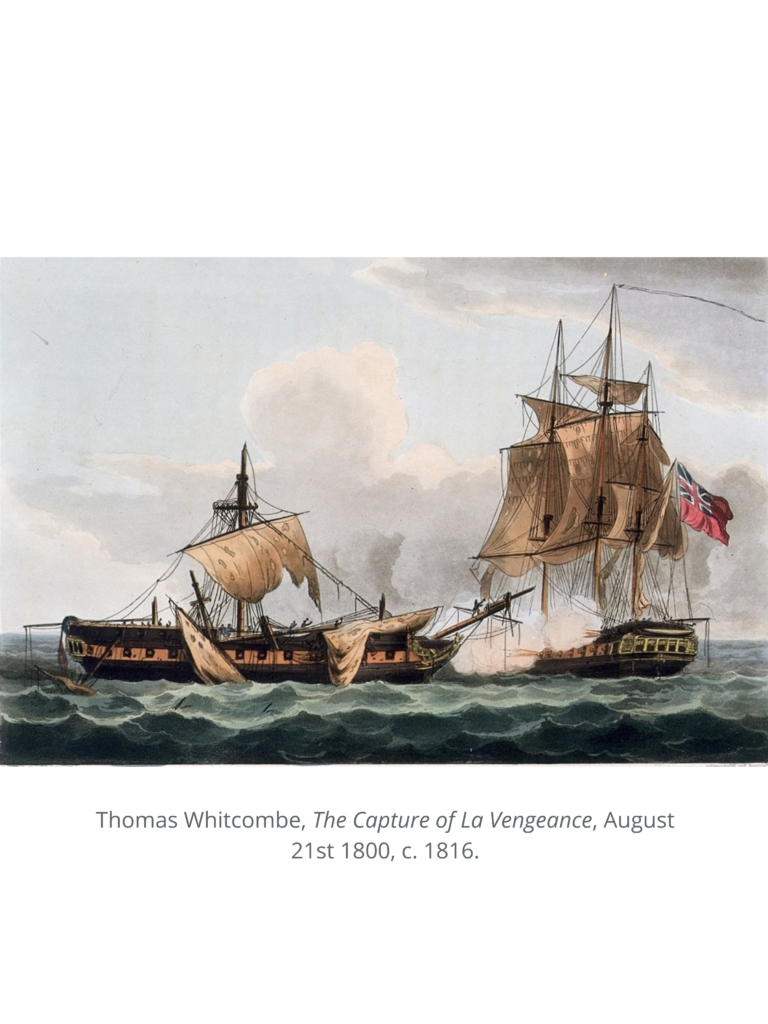
To compose the naval confrontation, Benedict drew on historical maritime paintings, including Thomas Whitcombe’s depiction of the capture of the French vessel La Vengeance by HMS Seine in 1800. This image provided a visual model for bringing the tradition of naval battle painting into the fictional scene from The Commodore.
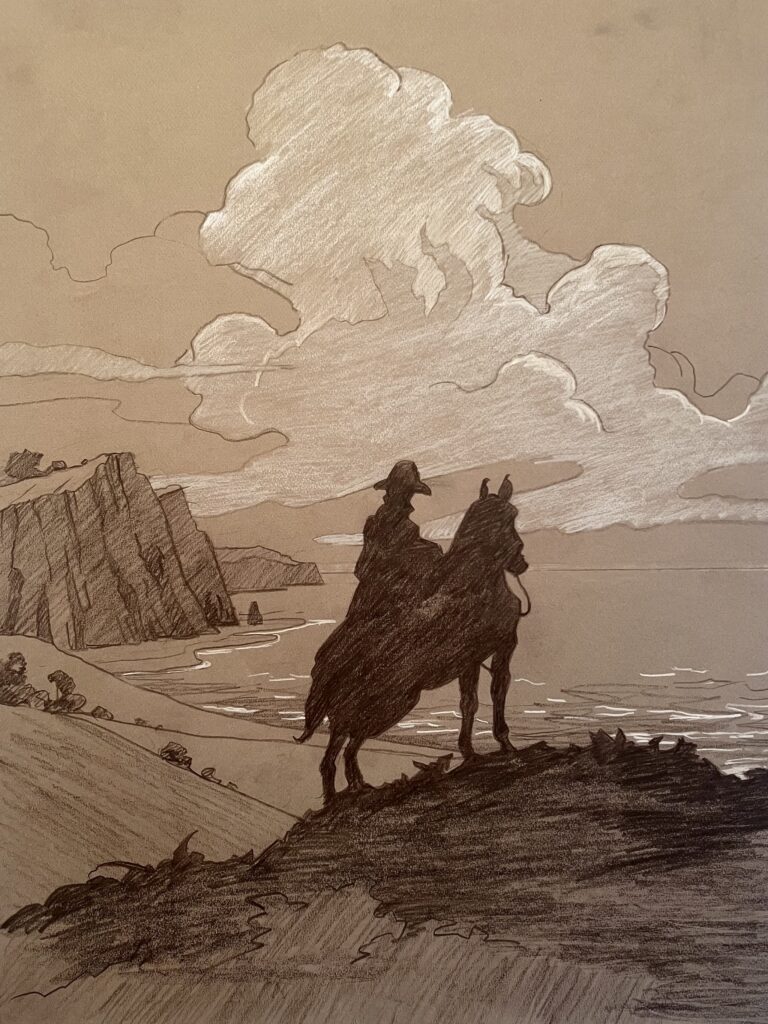
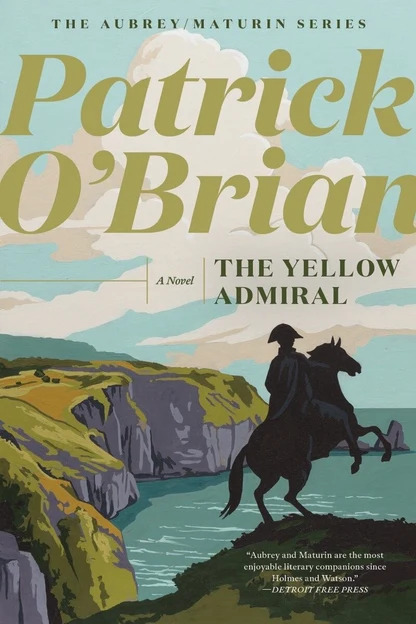
Captain Goldilocks in England
THE YELLOW ADMIRAL (Book XVIII)
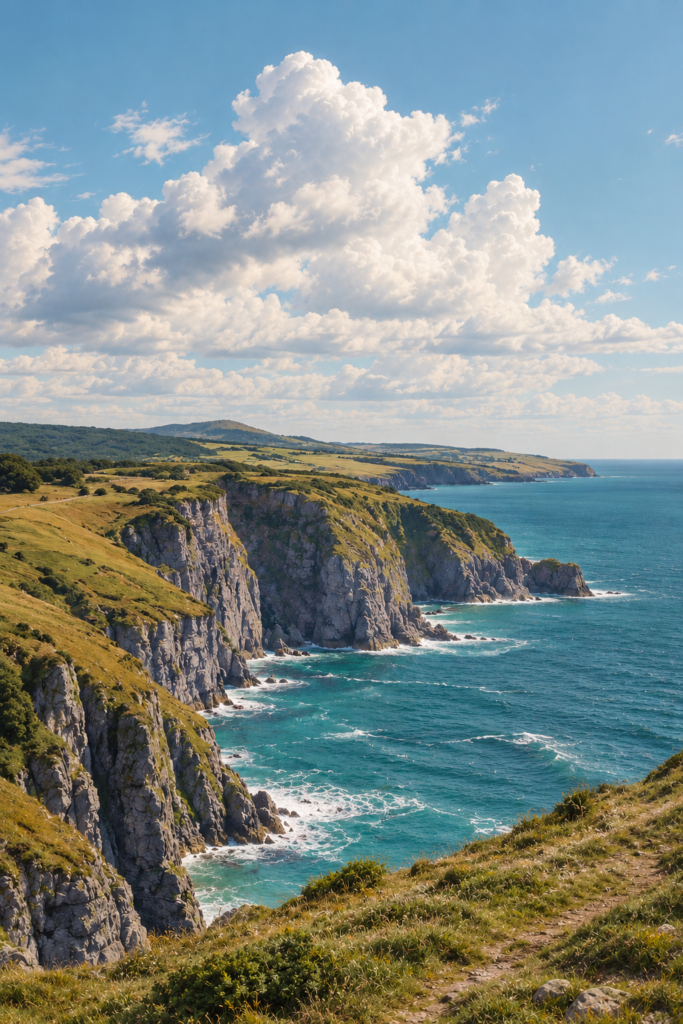
The eighteenth novel in the Aubrey–Maturin series, The Yellow Admiral, places Jack Aubrey in England, at his family estate of Woolcombe, as the Napoleonic Wars draw to a close. Temporarily removed from his customary voyages, Aubrey must confront uncertainty about his professional future and difficulties in his personal life. For this illustration, Matthew Benedict depicts the protagonist on horseback in the rural landscape surrounding his home.
The study is titled Captain Goldilocks in England, a reference to Jack Aubrey’s nickname, which alludes to his fair hair. Showing him on horseback, far from the sea and the ships that define his life, reflects the distinctive character of this instalment, in which the action moves away from the naval setting and into the English countryside. The landscape places the character in familiar surroundings, yet also at a moment of uncertainty, when his future in the Royal Navy remains unresolved.
The image offers a different perspective on the protagonist: not as a captain commanding a ship, but as a man on land, connected to his home and the life he maintains outside naval service. Benedict thus expands the series’ visual repertoire, revealing a side of Aubrey that contrasts with the maritime scenes depicted on the other covers.
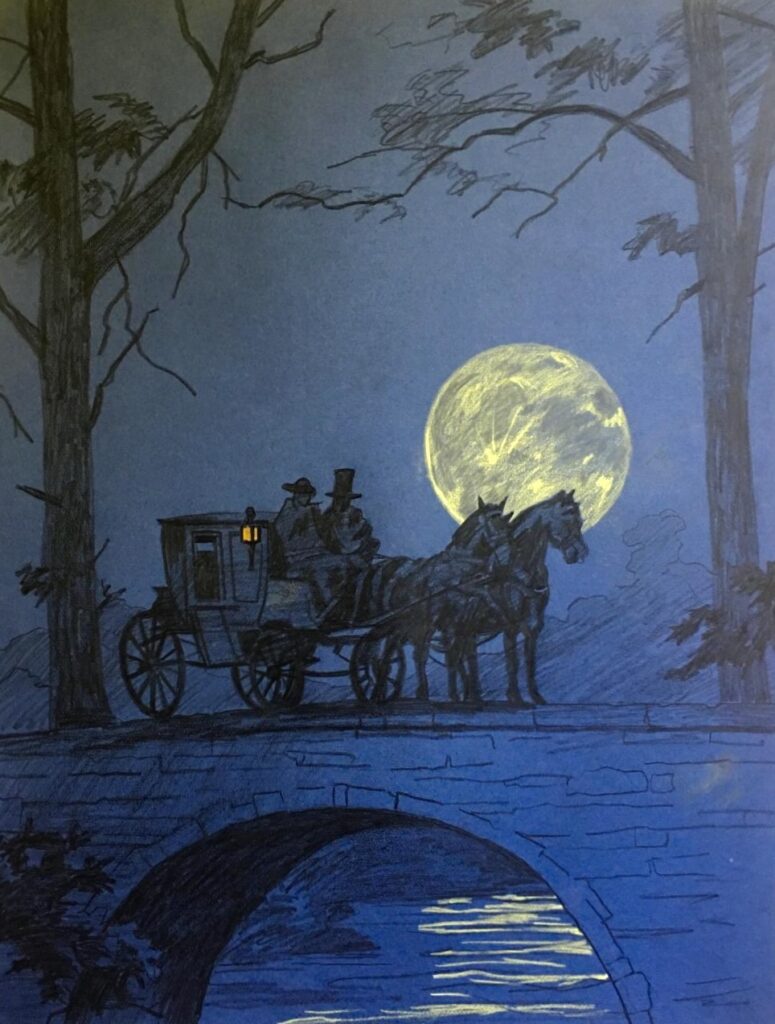
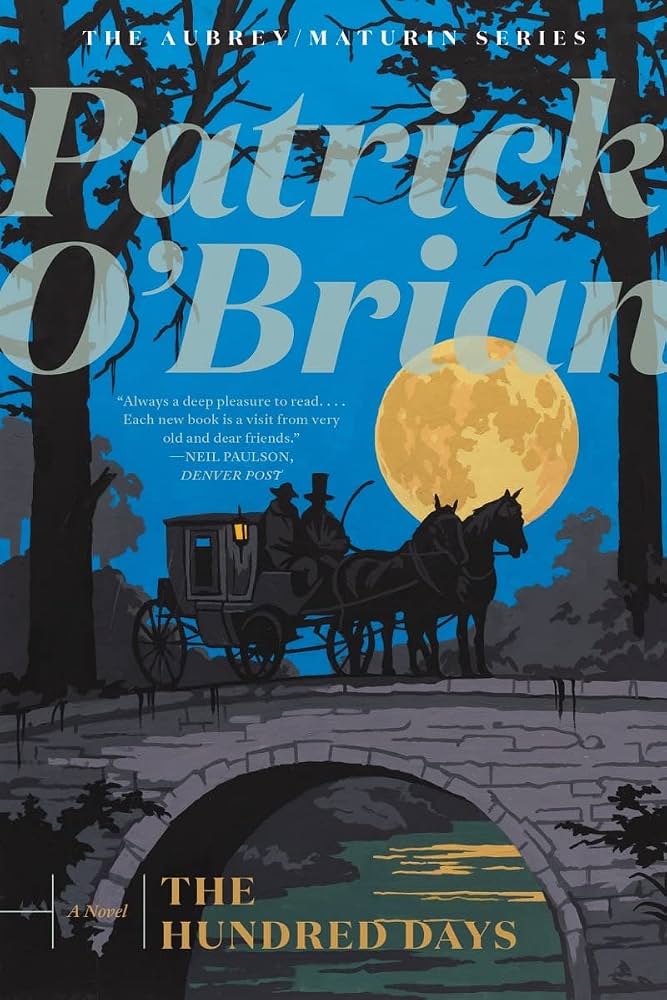
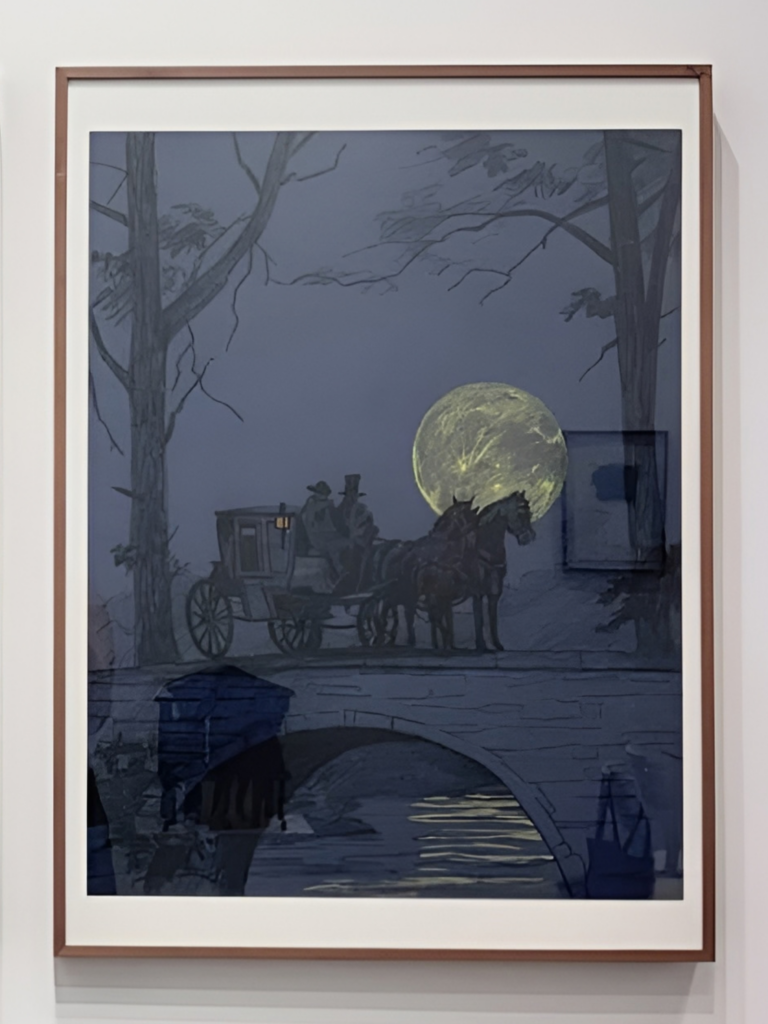
Death Approaches
THE HUNDRED DAYS (Book XIX)
The nineteenth novel in the Aubrey–Maturin series, The Hundred Days, takes place in 1815, during Napoleon’s Hundred Days, the brief period between his return from exile and his final defeat at Waterloo. For this illustration, Matthew Benedict depicts Diana Maturin and Captain Cholmondeley on the box seat of a carriage, at one of the novel’s most tense moments.
The scene takes place on Maiden Oscott Bridge, a fictional location created by Patrick O’Brian. The carriage approaches the narrow bridge over the river beneath the moonlight. The surrounding darkness and the confined crossing heighten the sense of danger, while Benedict directs the viewer’s attention towards the vehicle and its occupants.
The title, Death Approaches, anticipates the threat hanging over the characters without revealing the outcome. Through a nocturnal scene and a seemingly suspended moment, Benedict transforms a narrative episode into a composition charged with suspense. Unlike the naval scenes on other covers in the series, the tension here arises from movement on land, darkness, and uncertainty about what is about to happen.
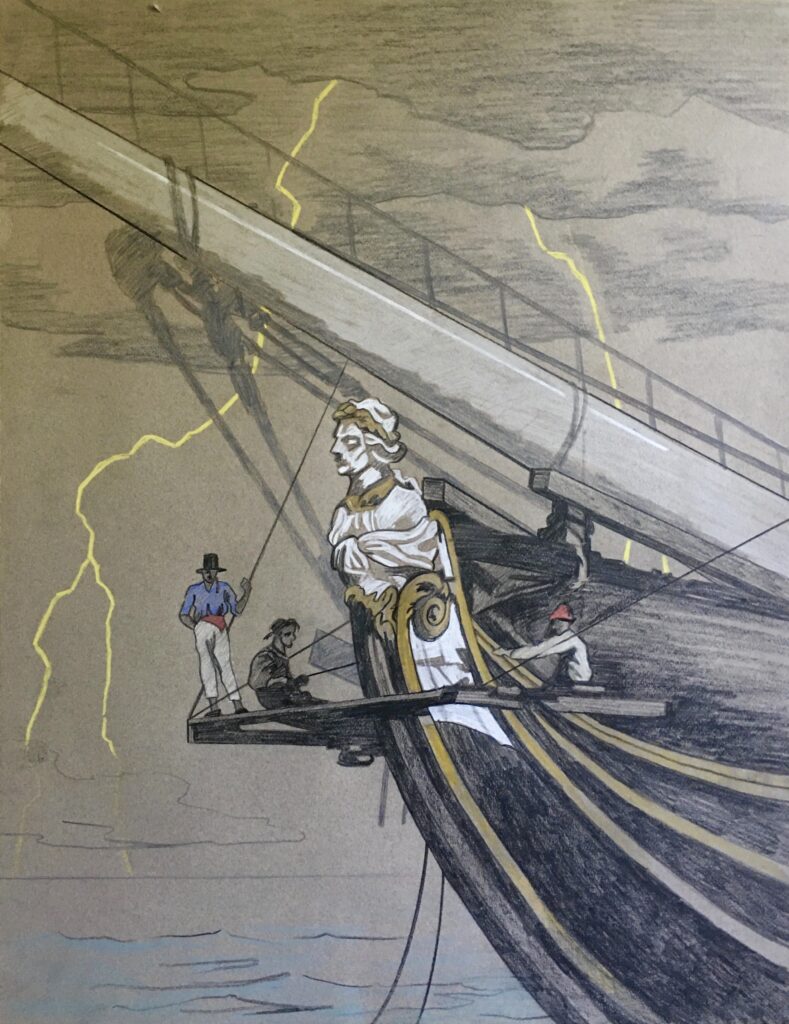
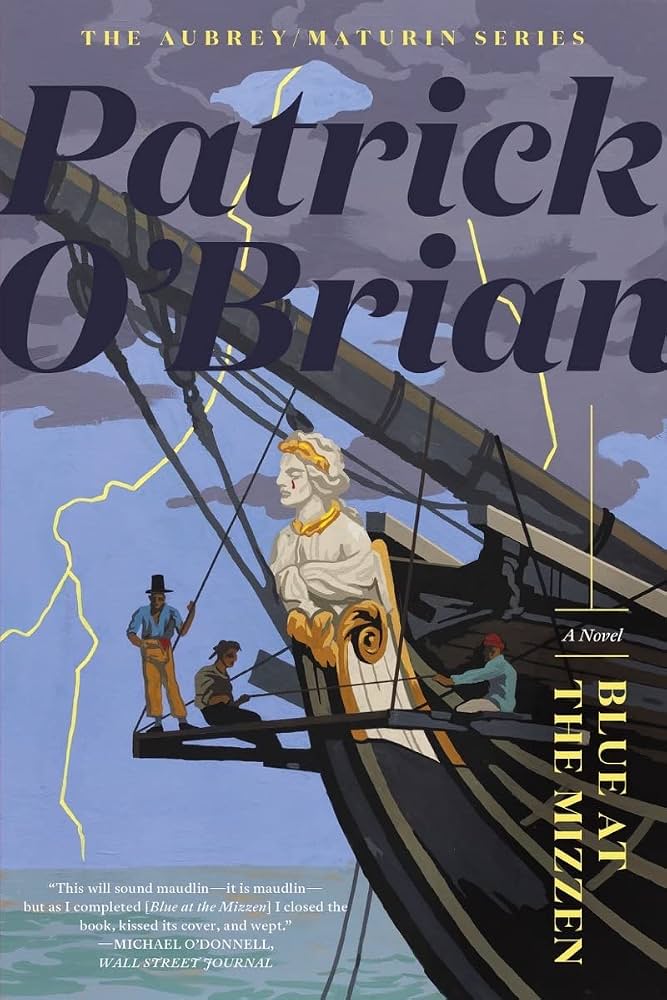
HMS Implacable in an Electrical Storm
BLUE AT THE MIZZEN (Book XX)
The twentieth and final completed novel in the Aubrey–Maturin series, Blue at the Mizzen, takes place in 1815, at the end of the Napoleonic Wars. In its closing pages, Jack Aubrey is promoted to rear admiral and given command of the British South Atlantic squadron aboard HMS Implacable.
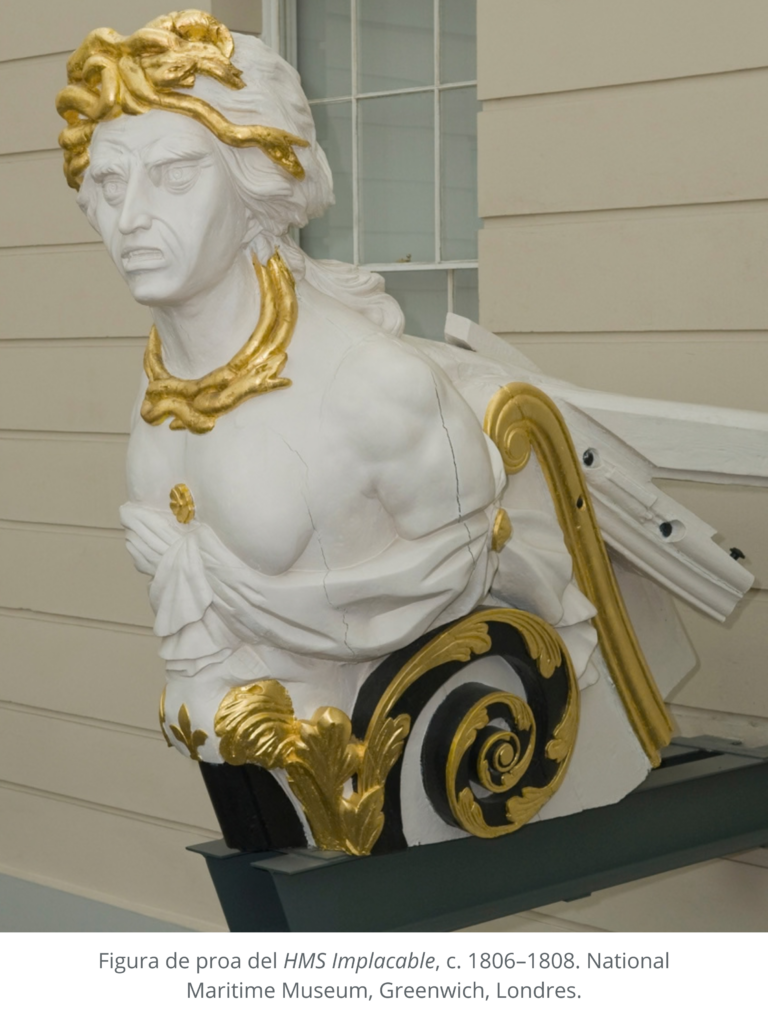
For this illustration, Matthew Benedict depicts the Implacable amid an electrical storm, focusing the composition on the ship’s bow and, in particular, its figurehead.
The title Alecto! refers to this sculpture, which genuinely belonged to HMS Implacable and is now preserved at Royal Museums Greenwich. Alecto is one of the three Erinyes of Greek mythology, deities associated with vengeance and punishment. Her name also carries a particularly fitting double meaning: it can be understood as “the relentless”, echoing the name of the ship itself.
HMS Implacable was originally the French 74-gun ship Duguay-Trouin, captured by the Royal Navy in 1805. Benedict draws on this historical vessel and its figurehead to create an image in which naval documentation, mythology, and the dramatic atmosphere of the storm converge in a single composition.
Matthew Benedict | Rockville, Connecticut (USA), 1968
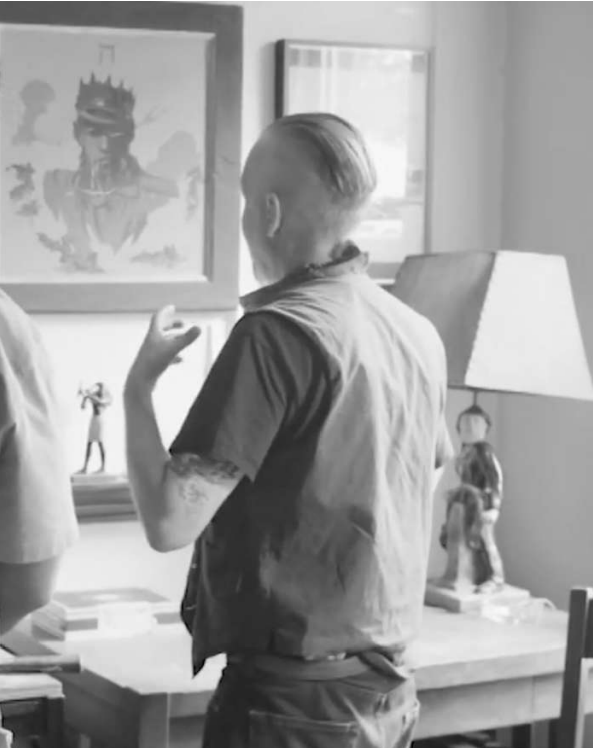
Matthew Benedict is an American artist who lives and works in Brooklyn, New York. His painting practice revolves around storytelling and the construction of visual narratives, through scenes in which history, memory and imagination intertwine.
Benedict works primarily with gouache on wood and paper, employing a deliberately flat, graphic visual language that draws on illustration and 19th-century didactic painting. His compositions are informed by archives, historical photographs and elements of American popular iconography, which he reinterprets to create scenes rich in historical, mythological and religious references.
Rather than depicting specific events, his paintings function as fragments of incomplete stories that viewers are invited to piece together. In these works, time and history become malleable materials, giving rise to worlds in which reality and fiction, the documentary and the imagined, coexist.
His work thus explores themes such as memory, transformation, heroism and the construction of narratives that shape our understanding of the past.
Benedict estudió en el School of the Art Institute of Chicago y obtuvo en 1991 una licenciatura en Bellas Artes por Eugene Lang College, The New School, en Nueva York. Su obra ha sido expuesta en galerías y museos de ciudades como Nueva York, Zúrich, Estocolmo, Madrid y Wuppertal, y forma parte de colecciones públicas como las del Museum of Modern Art (MoMA) de Nueva York, Hammer Museum de Los Ángeles, San Francisco Museum of Modern Art, Dallas Museum of Art y el programa artístico de la NASA. Ha recibido becas de la Joan Mitchell Foundation, la Fundación Claude Monet en Giverny y la Adolph and Esther Gottlieb Foundation.